
David Harbour Visits the Twin Cities to Talk Stranger Things, the Acting Process, and the Draw of Nostalgia
David Harbour has been a character actor for years, but he’s perhaps best known as the gruff Chief Hopper from Netflix’s hit horror show Stranger Things. Ahead of the third season debuting on July 4, 2019, Harbour stopped by the Mall of America for a fan event to talk about not just the show but his approach to acting and the series’ nostalgic appeal. I had the chance to sit down with him before the public Q&A to ask him a few questions of my own.
The new season looks to be a much different experience than the previous ones. Unlike the first two, which took place in the fall, season 3 will have a story to match its summer release date. The latest trailer, which was also screened at the mall event, showcases that much of the story will take place at summer spots of the pool and a town carnival. And terror will certainly be returning once more to the town of Hawkins.
Getting into Character
In Stranger Things as well as in such films as Hellboy, Harbour is no stranger to playing antiheroes with troubled pasts. As such, he tends to get rather deep into his roles. “I try to be as personal as I can,” he said. “Sometimes that means on certain days I have to be a little more intense than other days. There would be some light days of filming where we were doing easier stuff and I could stay out of it, and then there were days where I would just want to maintain that energy between us. Sometimes that was not so much fun energy, but it’s one of those things where I feel like if you actually bleed a little bit that it resonates a lot deeper. So it’s part of the job [. . .] It sort of depends on the day.”
Digging a little deeper into playing troubled characters, we touched on how this aspect within Chief Hopper has evolved over the course of the seasons. I asked whether there were parts of Hopper that Harbour felt bled into the areas of antihero. “I think that Hopper has a lot of levels,” he said. “But certainly, in the first season, he was dead inside as a result of this tragedy. And the first season was really about him waking up.”
The actor clearly relishes exploring the character’s complexities. “He still has those jokes, like there are certain ways people use shtick when they don’t wanna feel anything,” he continued. “I think that he was that way, and we’re able to peel back the onion in season two around him being a father and I think even this year there are even more layers to him.”

Just a little friendly competition with Finn Wolfhard.
Moving into season 3, Harbour noted there was still more to explore with Hopper and his conflicted nature. “There’s so much tapestry left [. . .] like we see in little ways. Like in season two, he did those trip wires with Eleven. And it’s like, ‘How does the guy know how to make trip wires?’ Clearly, he was in Vietnam. He was a cop in New York.”
Given such a backstory—which also, of course, includes the loss of his daughter in the years before the show’s events—there are a lot of layers to the character. “He does perform heroic actions, but not always for the right reasons. Sometimes he performs nonheroic actions for not the right reasons. I think that’s just like the tapestry of life. I don’t think life is so clear cut as good and evil. it’s always a mix of light and dark.”
There’s been an undeniable progression in the chief’s character over the course of the show, and a different side of him has seemed to come out with each season. I asked Harbour whether that evolution has been a natural progression or if he’s done something deliberately different with each season to get to the Hopper that needed to be on screen.
“It’s very different,” he said. “In fact, one of my interests in [Stranger Things] is that we have a certain number of seasons, and I don’t want him to remain consistent—I mean, I want him to remain consistent, but I also know that as human beings [. . .] you’re encapsulating the life of a man in however many years. And so in that way, I wanted to be as broad-based as possible.”
This has extended to Hopper’s physical appearance as well. Many fans noticed his mustache in the images for season 3, but facial hair isn’t the only aspect that’s changed over the seasons, and Harbour commented that was something he related to personally: “I myself [. . .] gain and lose weight for various reasons. Or change my look or appearance for various reasons. Or change my mentality or my psychology because of needs that are either uncovered or expressed. And so in that way, it’s a strange thing with a television show, because you want it to still be Hopper—the Hopper that you love—but you also want to push boundaries and you want to see how far we can go with this guy.”
On the character development side, Harbour said, “People always surprise you, and they’re always full of contradictions. I think that in our world nowadays we’re getting so binary with people being defined by either their political beliefs or what they say online. The consistency is [. . .] I don’t even think it’s desirable as a human being.” This observation wasn’t commenting on anyone in particular but was more an expression of how the actor views both other people and himself. “I myself will change my opinion from the morning to the afternoon. And I think that’s a wonderful thing about being a human being and able to grow. So in that way, I like Hopper to be complicated. A character is somewhat important for a story in terms of consistency, and also I feel like in and of itself is an illusion. I like the fact that we can play with that idea.”
Retro Flavor
Moving on to the setting of the show, we shifted the conversation to the 1980s. There’s no doubt that retro romance of the ’80s is rampant in current media and fashion, and Stranger Things is one of the more prominent nostalgic love letters to the decade. I was curious how Harbour felt about this trend and what about the era has resonated for younger audiences who didn’t experience it firsthand.
“It’s an interesting question, because I was touched, but also confused,” he said with a laugh. “As you say, it’s not their world. So why do they get so into the ’80s in that way? There’s something about the space that [meant] we had to interact. And I mean that on every level. Metaphorically, but also we didn’t have our phones. We had bikes. We had these big open spaces. And we got bored a lot more. I think there’s something about that I miss. The nostalgia might be a lot better than the actual reality.”
Elaborating on that rose-colored viewpoint, he went on: “You can update the nostalgia in your brain, but I think there is an innocence lost that we all feel and we wanna get back to this time when things were simpler and clearer as life inevitably becomes more complex and gray and confusing. There is a simplicity to that era.”
It’s not all about philosophy, of course. “I dunno, it’s colorful,” he said with a laugh. “It’s a weird era—the hair is terrible! It’s great! Shoulder pads! The ties with pianos on them!”
On that note, I had to ask what 1980s item Harbour adored the most, considering how much of it decks out the sets of Stranger Things. The answer? His mom’s Polaroid camera “I remember her taking photos when we were down in Houston and stuff that we still have. [. . .] It wasn’t an immediate response, where now we just take a picture and we know what the image is. Back then, you had a camera and you took 36 pictures or something and you dropped them off for a week. And then you got them back, and you were like, that one’s good and that one’s not! Whereas now we can just take a hundred selfies and choose the one. So I like the film of that era.”
But what was easily the most entertaining part of the interview was when I brought up how the resurgence of vinyl has tied back to the 1980s nostalgic wonderment. I mentioned how the clerk of a local record store had mentioned their most popular vinyl soundtrack being The Breakfast Club, which prompted Harbour to start singing Simple Minds’ “Don’t You (Forget about Me).” We had a laugh and ended the interview on a great note.
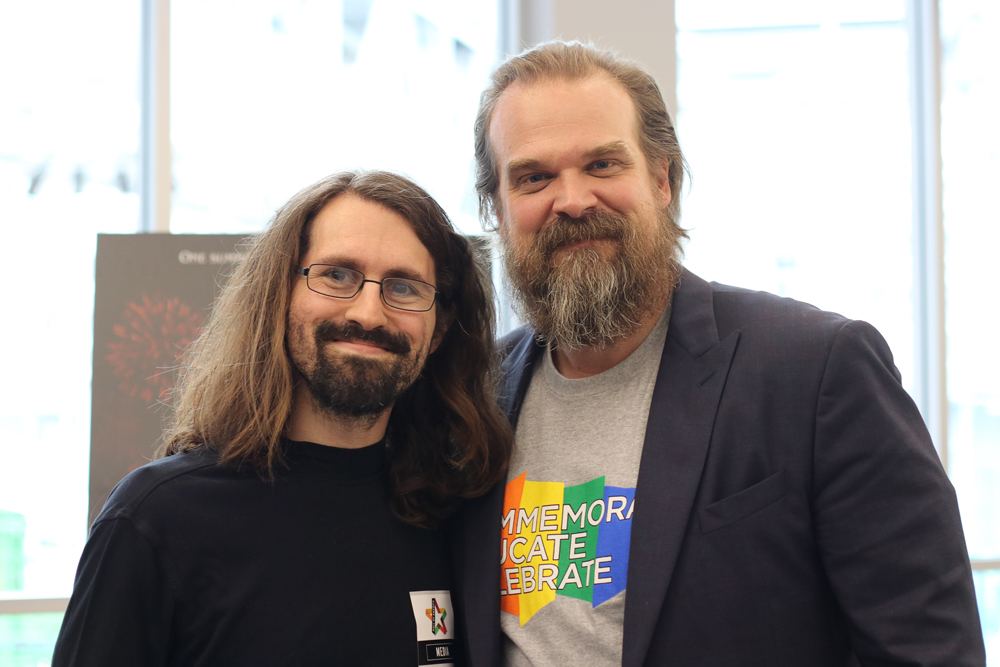
Mark McPherson and David Harbour.
It was great to get the actor’s insight into some of the flaws and complications in the characters he plays, both fun and dark, and hear his open way of talking about the tougher aspects of the job. After playing Hopper for three seasons, it’s certainly been a journey for Harbour transforming from a tortured and apathetic lawman to a conflicted father figure to Eleven. It will be very interesting to see where he goes next in the new season.
Follow @TwinCitiesGeeks on Twitter or Like Twin Cities Geek on Facebook for more great stuff from Minnesota geeks in your feed!
About the Author

Mark McPherson
Mark is a moonlighting movie critic for various websites. A video-store veteran and lover of the medium, he is up for watching just about any movie (yes, including that one).


