
A Few Thousand Tardigrades May Now Be the Sole Inhabitants of the Moon
It was a sobering moment: Israel’s first moon lander came up just short of its mission, crashing into the gray dirt of the lunar surface on April 11, 2019. The Beresheet spacecraft, named for the Hebrew word for Genesis and constructed by SpaceIL, was to be the first privately funded spacecraft to land on the moon. It was a valiant effort but ultimately went down as another expensive example of the true difficulties of spaceflight and left its teams to regroup and rebuild in hopes of trying again in the future.
But the story does not end there.

An artist’s rendition of the Beresheet spacecraft on the surface of the moon. SpaceIL
Housed within the frame of the four-legged spacecraft was a so-called lunar library consisting of over 30 million pages of information, human DNA samples, and a time capsule containing various effects reflecting Israeli culture—such as children’s drawings, written reflections, songs, memories of a Holocaust survivor, and the text of the Torah. It’s unknown whether the digital contents of the lunar library or the time capsule are intact enough to recover, but aside from this, Beresheet held other cargo: a few thousand tardigrades.
Tardigrades are a group of eight-legged, water-dwelling microcreatures that bear a slight resemblance to a chubby caterpillar crossed with a pig. Endearingly referred to as water bears or moss piglets, they have fascinated us since their discovery in the 18th century by the German zoologist Johann August Ephraim Goeze. More recently, a multidimensional giant tardigrade was a plot point on Star Trek: Discovery, and there was an entire fan panel dedicated to the critters at this year’s CONvergence. Why the interest? Sure, they’re weird and adorable in their own strange kind of way, but it’s their near-indestructibility that’s really earned them their reputation over the years. Not only have they been found to live and thrive in some of the most extreme environments on Earth, but they’re the first animals to have shown they can survive in the vacuum of space.
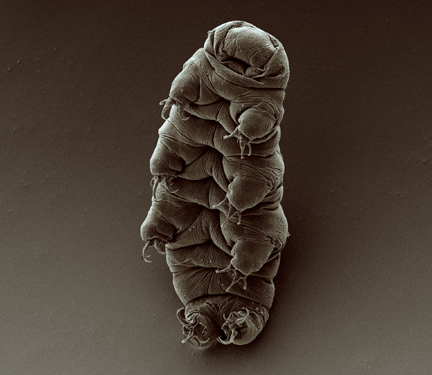
A scanning electron micrograph of an adult tardigrade. Wikimedia Commons/Goldstein Lab
With this in mind, the recent announcement from the Arch Mission Foundation, the organization behind sending the lunar library aboard the Beresheet, that the tardigrades may have survived the crash might not actually be that surprising. In an interview with Wired, foundation founder Nova Spivack stated, “our payload may be the only surviving thing from that mission.” Spivack believes that, while it’s not confirmed, there is a strong possibility that Beresheet may have ejected the foundation’s lunar library upon impact—meaning its contents may still be intact somewhere on the surface. If that’s the case, the tardigrades are likely to have survived the crash.
If Spivack’s beliefs turn out to be true and the tardigrades have survived, they will remain in a dehydrated state and would need to be revived by future humans on the moon in order to return to their natural state. So until then, there’s no worry of a tardigrade takeover of the lunar surface, but when the question of whether or not there’s life on the moon comes up, we can all now say that maybe there is.
Follow @TwinCitiesGeeks on Twitter or Like Twin Cities Geek on Facebook for more great stuff from Minnesota geeks in your feed!
About the Author

Joe Praska
Joe is an elementary-school teacher in Minneapolis with a particular excitement for teaching science. He began to dabble in writing and blogging in 2013 and has spiraled further and further down the rabbit hole ever since.


