
Twin Cities Shops Focus on Building in-Person Community
We’re almost at the end of the gift-buying season that began with the holiest of days for the holiday shopper, Black Friday. Millions of Americans have been storming retailers looking for deals on TVs or the hottest video games, toys, and games in search of the perfect gift for that special someone in their lives. Increasingly, though, consumers are looking to e-commerce to avoid the chaos that is Black Friday and the last-minute-purchase landscape. With the rise of e-commerce and mass merchandisers, specialty brick-and-mortar retail has become a graveyard of bankruptcy littered with the tombstones of Toys “R” Us, RadioShack, Sports Authority, and numerous others. It looks to be a difficult time to open a brand-new store catering to a local market.
Even our own geek market has been hit hard, with the closing of Creative Kidstuff and several local comic-book stores, including a recent store whose opening we covered earlier this year, Epic Comics and Collectibles. The news in the local industry is dire and has gotten worse over the last year. The early part of next year will be telling as Minnesota businesses start to feel the impact of impending trade tariffs. But some local shops have found a way to succeed by focusing on something that isn’t new but is increasingly becoming demanded by local shoppers: experiential retail.

On Black Friday, Source Comics & Games sold some of its board games at a significant discount. Source Comics & Games
Experiential retail has been on the rise. Spurred by consumer spending shifts, shops are looking to take advantage of consumers who are primarily looking for live experiences rather than retail goods. One example is Starbucks’s Reserve Roastery, a high-end bar/coffee shop that makes three to four times the revenue of a typical store. Those failing to adapt to this need for experiential retail have found themselves obsolete, driven into the ground by e-commerce’s ability to build custom recommendation algorithms based on preferences, personalized email content, and individualized social media posts recommending purchases based on a person’s personality, style, or unique interests. This experience, for the most part, is much better than wandering aisles trying to find the one thing you are looking for. Brick-and-mortar stores have to provide an experience to the consumer that engenders a sense of community building. For our local stores that cater to nerds, this concept of experiential retail is not new—in fact, it’s what I believe has allowed them to survive while other large brick-and-mortar retailers have seemingly lost their way.
When you touch on the fall of specialty brick-and-mortar retail, everyone seems to point the finger at Amazon and the convenience and personalization it provides, while failing to point to the inherently bad experiences of most archaic brick-and-mortar stores. I interviewed a few local shops in the Twin Cities market to understand what has allowed them to survive in this competitive market: Tower Games, Heroic Goods & Games, and Source Comics & Games. These local shops understand that the consumers looking for the lowest price on Amazon or at Walmart tend not to be the people who add a lot of value to local shops over the long run. Bob Seabold, owner of Tower Games, put it nicely when he said, “I’m not looking for price-sensitive customers; I’m looking to engage people who want a particular type of game, personal interaction, a nice place to be.” The people I spoke to are not trying to beat Amazon with the lowest prices; it’s a game they can’t win given the clout Amazon has in the market. Instead, local retailers are heavily focused on building experiences and going after people who are looking for community and personalized experiences, especially because this builds loyalty at their stores.
It’s this cultivation of community that seems to allow these stores to exist in a local market. As Paul Zenisek, the owner of Heroic Goods & Games, said, “Customers come to our store because it’s a great store, and you feel welcome. If you want a new board game, we will talk to you and find a game that fits your needs. If you want to talk about how exciting it was that Sonic 3 released on your 12th birthday in 1994, we will talk about that. Try doing either of those things in a customer chat window on your computer and see how far that gets you.”
Gene Seichter, head of games at Source Comics & Games, also expanded upon this point, remarking that the store draws customers in “by offering service, expertise, and a welcoming environment that they cannot get by shopping online. We offer events, organized play, classes, and many other things to engage and create a community for our customers.” Source Comics & Games is not alone in this. If you’ve happened to look at some of your local gaming shops, what separates them significantly from big-box retailers and e-commerce is the events calendars many of these stores put together. Take the Source’s event calendar, for example. The store has multiple events going on most nights to bring people in, allowing them to meet other people who are passionate about the same things. This community building is what keeps our local stores alive, as many of us desire some level of personalization as we shop or even just want to enjoy a night at a local establishment meeting new people.
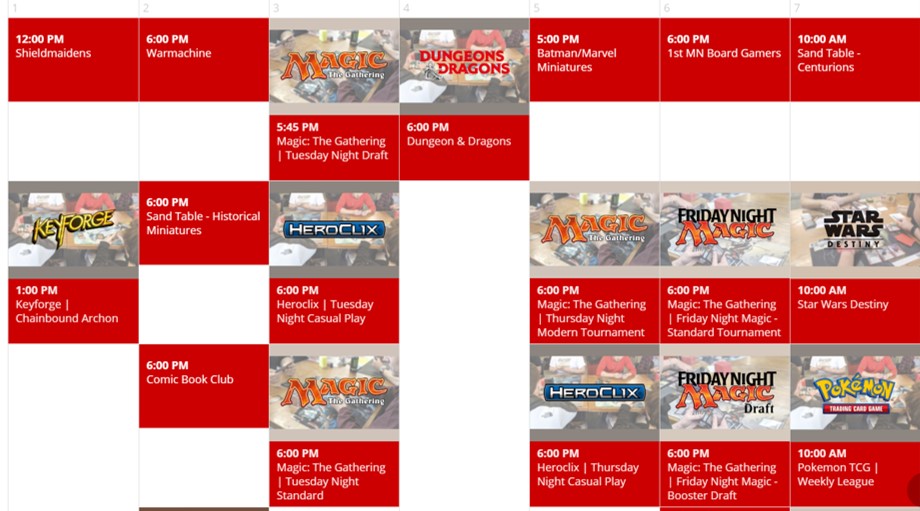
A look at Source Comics & Games’ event calendar, showcasing key events like Keyforge, Magic: The Gathering, and Star Wars: Destiny group play in-store. Source Comics & Games
What I took away from these discussions with local business owners is that beyond the ways they are looking to build community in the local market, they genuinely care about the people who come into their stores. They are not looking to have a quick transaction and send you on your way; they are looking to find out more about you and recommend a game or experience that you are genuinely going to enjoy. This might not be as sophisticated as a mathematical equation designed to predict your behavior based on your purchase history, but it feels more genuine than those triggered emails from Amazon.
Time will tell if this strategy continues to pay off for our local stores. At any rate, my hope is that this continues to be effective and our community continues to support local businesses, as I, for one, do enjoy the personal experiences and the sense of community I feel going into small business locations. I am supporting local businesses in my Christmas shopping, and I hope you do too.
Follow @TwinCitiesGeeks on Twitter or Like Twin Cities Geek on Facebook for more great stuff from Minnesota geeks in your feed!


