
Star Trek: Picard Exceeds and Defies Expectations
Over the course of 178 episodes and four films, Star Trek: The Next Generation solidified its legacy among Trekkies, myself included. From 1987 (the year of the pilot, “Encounter at Farpoint”) to 2004 (the year of the fourth and final Next Generation film, Nemesis), the crew of the USS Enterprise-D and, later, Enterprise-E fully lived up to and arguably surpassed the original series in every way. This was thanks in no small part to the commanding presence of Captain Jean-Luc Picard, played with unparalleled brilliance by the legendary Sir Patrick Stewart.
Because of the near-flawless run of The Next Generation and Stewart’s incredible performances, I was cautiously optimistic when Star Trek: Picard was announced. I’m a hardcore, lifelong Trekkie, so I was definitely excited about a return of one of the most engaging (see what I did there?) Starfleet captains of all time, but I was also a little nervous. Would this be as compelling and original as Star Trek: Discovery, or would the creators just follow the trend of so many other productions in recent years, leaning hard on dredging up old content rather than building new, quality material?
CBS
As the series was debuting relatively soon after the fantastic second season of Discovery, I worried my beloved Trek community was about to be handed its own Starfleet version of what The Force Awakens had been for Star Wars. And when the announcements of older cast members joining the Picard roster kept rolling in, I was even more concerned, almost convinced the new show would be a let-down.
But from the two episodes that have been released so far, it’s clear that Picard isn’t some hastily thrown-together nostalgia bait. It’s not even really a Next Generation sequel. It’s expanding the Star Trek universe in surprising, mature, and wholly captivating ways. In Trekkie terms, it is to The Next Generation what The Next Generation was to the original series.
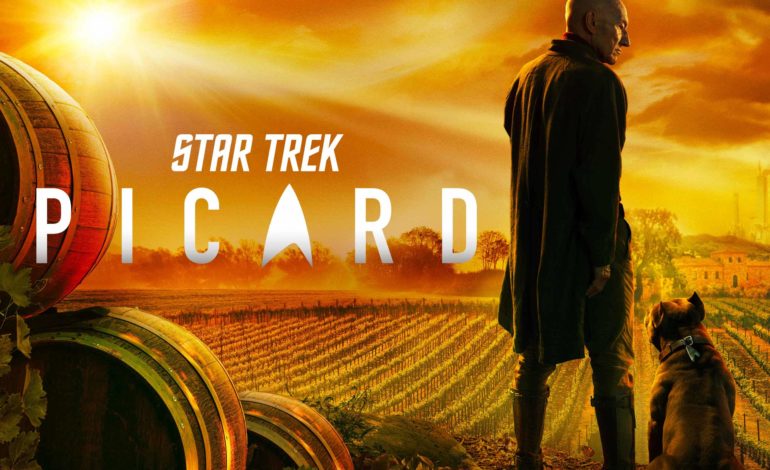
With only a 46-minute run time, the Star Trek: Picard premiere deviated from the established norm. Of the six Star Trek series released since 1987, five have kicked off their runs with feature-length premieres (or, in the case of Discovery, a two-parter with a combined total run time of over 90 minutes). But “Remembrance” launched the new series with a shockingly action-packed episode. We first meet Picard as a quiet civilian, living on his family’s vineyard. Apart from having odd dreams of his old crewmate Data, his post–interstellar diplomat/explorer years are not too far off from how most Trekkies probably pictured it in their pre-2020 fanfiction. But then we learn why Picard left Starfleet, and the realization sets in that this won’t just be the old Star Trek with a new production budget.
Note: While this article does not contain spoilers, some general story elements in the first two episodes are mentioned in the next two paragraphs.
His idyllic retirement is uprooted completely when he’s visited by a mysterious young woman named Dahj (Isa Briones) who has been seeing visions of him. After a long talk laden with Easter eggs, he believes her story and agrees to help her. We also learn early in the first episode that Picard left Starfleet because of what he considers its callous apathy in the face of a humanitarian crisis. This detail is perhaps the most Star Trek–ish, as like all of the great Trek plot points it’s both topical and timeless.
The second episode, “Maps and Legends,” starts with some contextual backstory (and more Easter eggs!), sending us back a decade and a half to the Utopia Planitia shipyards on Mars—on First Contact Day of all days, in another nice nod to the previously established canon. (For those of us who have been watching Star Trek: Short Treks, there is also a nice tie-in with the episode “Children of Mars.”) Back in the present, Picard, with the help of some Romulan companions, continues his investigation around Dahj, looking for answers despite every lead seeming to create more questions.
Two episodes in, it’s already clear Picard will be closer to Deep Space 9 and Discovery than to The Next Generation and the original series. Unlike like the latter two, Picard is sequential—missing the first episode definitely would make the second almost indecipherable, and it’s fairly safe to assume that will continue to be the case moving forward. The tonal range is also a lot darker than The Next Generation or even Voyager. This is not the dashing, adventurous Captain Picard on the bridge. This is a Picard who is jaded, hardened, and disheartened by the actions of an organization to which he dedicated a significant portion of his life. Free from the restrictions of Starfleet regulations and protocol, he’s not doing what he’s been ordered to do. He’s doing what he believes is necessary and, most importantly, what’s right.
Some viewers may find the sinister undertones around some of the story elements to be a little off-putting. Some might not be keen on the serialized nature of the show. But both the series and the character have evolved to fit the format and storytelling approach of the contemporary audience. When Star Trek: The Original Series was on the air, it followed the format of other 1960s programs; although the content was groundbreaking, the pacing and camera work were par for the course for that era. The same was true for the subsequent Trek series with the exception of Deep Space Nine, which was way ahead of its time in terms of how the seasonal arcs played out. Now look at the state of modern programming. Game of Thrones, Breaking Bad, pretty much every Netflix and Hulu original series—they’re all solid, semiserious serials (even the comedies), in which missing one episode severely compromises the narrative flow. Even older series like Sex and the City, The Sopranos, and Firefly used chapters in an overall story as opposed to individual episodes connected only by the same characters and similar themes. Picard keeps alive the grand Trek tradition established by the original series: phenomenal content laid out in a format typical of the times.
So, production and directorial techniques aside, how is the show?
In a word, phenomenal. The Picard of Picard is a natural continuation of the Picard from The Next Generation. Stewart hasn’t missed a step; it’s almost as though when production wrapped on Nemesis, he immediately began working on this new series. He walks the imperceptibly thin line between rehashing a character and reprising a role. This is the same Jean-Luc we grew to love through the late ’80s to early aughts, but it’s been a few years. Stewart plays him believably as someone who has lived through those years and had experiences that impacted his outlook. Much like an old friend you run into after not seeing for a while, he’s still the man we know, but poignant and subtle changes shade his characteristics, mannerisms, and beliefs. The supporting cast is used sparingly, at least so far, but in a manner that adds depth to the series. They’re not just set pieces for Stewart to bounce off of and react to but fully developed, multifaceted individuals in their own right. The focus is on the titular star, of course—this isn’t an ensemble program like most of the other Trek shows—but what the cast lacks in quantity of scripted lines is more than made up for with the quality of the lines they’re given.
My only criticism is that the first two episodes are heavily front-loaded. We’re introduced to Picard and the mystery around Dahj, and that would’ve been sufficient to carry a season arc, but within the combined 90 minutes, we see numerous interpersonal conflicts, curious medical conditions, shadowy organizations operating behind other shadowy organizations, double agents double-crossing other double agents, and are new character introductions at a rapid-fire pace—some of whom have ulterior motives, questionable objectives, and extremely contentious, slightly antagonistic, history with Jean-Luc. That’s a lot of plot to keep track of as a viewer, and while it makes for an engaging and rich story, it also makes me a little nervous. With so many narrative lines and arcs to flesh out, explore, and wrap up, I worry that Picard may face the same issue the final season of Game of Thrones struggled—and, depending on which fan you ask, failed—to solve.
I should also mention that CBS is definitely taking advantage of the freedom for profanity that the subscription model of a streaming platform allows. We get not one but two F-bombs in the second episode, and a vulgar term for excrement is thrown around a bit as well. To their credit, the writers seem to be using the profanity to awkwardly humanize the characters rather than for shock value or to contribute to erroneous notions of grittiness. But it can be a bit jarring to hear, especially considering that prior to CBS All Access, in over half a century, the language has always been free of “real” swear words—with only two real exceptions, one mild and one semiridiculous.
Overall, Picard lives up to the anticipation that began building when the series was announced. The balance between hard science fiction, whodunit drama, and intense action sequences (at least one of which is on par with the likes of Jason Bourne and River Tam) is masterfully maintained. Trekkies will enjoy the attention to detail and clever nods to canon that don’t interrupt or undermine the stories and scenes. New fans won’t feel left out or like they need to do a lot of homework to dive in and keep up—although if you’re so inclined, I’d recommend the Next Generation episode “Measure of a Man,” the Short Treks episode “Children of Mars,” and the film Star Trek: Nemesis. And new and old fans alike will love the sharp script, exciting action sequences, gorgeous visual effects, and dynamic performances of a brilliantly executed science-fiction series.
Star Trek: Picard is streaming on CBS All Access, and the first episode is available for free on YouTube until February 5, 2020. New episodes are released on Thursdays.
Follow @TwinCitiesGeeks on Twitter or Like Twin Cities Geek on Facebook for more great stuff from Minnesota geeks in your feed!
About the Author

T. Aaron Cisco
T. Aaron is a local science-fiction author, award-winning television producer, veteran touring musician, lifelong Trekkie, co-founder of TC Trek Trivia and Wibbly Wobbly Wednesdays (Doctor Who Trivia), contemporary fashionisto, and above all else, an incorrigible nerd.


