
Comics I’m Picking Up the Week of April 8, 2020
Here are the books I’m picking up the week of April 8, 2020, to supplement distance learning.
With a hybrid distribution model for new comics just ramping up and most publishers holding off with digital-only distribution (ongoing manga titles seem to be an exception), I am wondering what everybody is reading. Married to a school librarian, I am constantly hearing about how elementary-age kiddos are asking for more graphic novels and am heartened that more and more resources are being devoted to getting books into the hands of the readers that want and need them. Most parents will likely be familiar with the works of Dav Pilkey (Dog Man, Captain Underpants) Raina Telgemeier (Drama, Smile, Guts), Judd Winick (Hilo series) and Elisabetta Dami (Geronimo Stilton), but what if you want something more closely tied to your child’s curriculum?
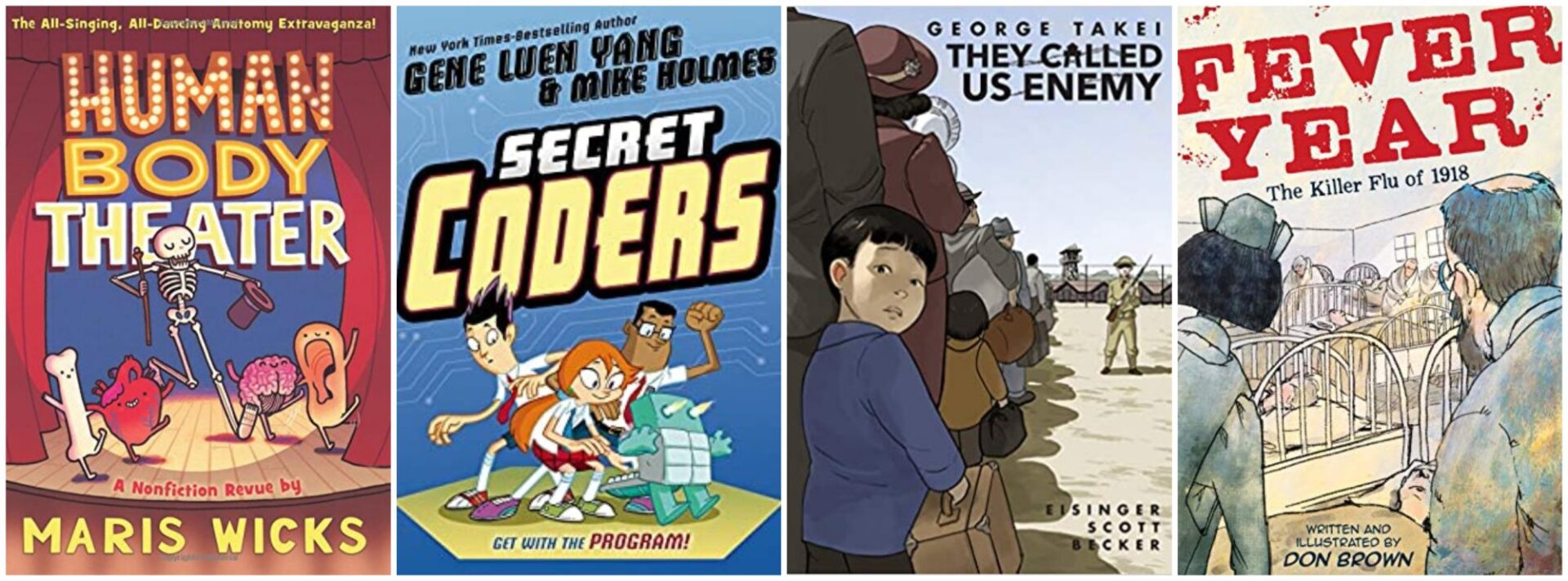
Because of the multilingual ways that sequential art presents different content areas (yes, arrangement of pictures on a page is indeed a type of language) they are a good way to reach out to someone struggling with the way a particular concept is presented in text-only formats. Science was difficult area for me to understand in elementary school (especially some of the Latin-derived words in biology) but Maris Wicks’s Human Body Theater (First Second Books, 2015); Primates (Square Fish, 2013) by Jim Ottaviani and Wicks; and Paige Braddock’s Stinky Cecil books (Andrews McMeel Publishing, 2015, 2016) would have been a good supplement to the books I had in class. Or if I had wanted a more basic understanding of the scientific method I could have looked to Max Axiom for a more adventurous presentation.
My “technology” education began with learning Logo, which primed my synapses for geometry, trigonometry, and the “gravitational mechanics” that got used so prevalently in sci-fi of the early ’90s. Today I might rely on Gene Luen Yang and Mike Holmes’s Secret Coders (First Second Books, 2015) to arrive at a programming framework and maybe ask an adult to use a copy of Visio to design a process map or ask what it means to document data flow (yours truly could do that).
Where graphic storytelling got its most sustained classroom foothold has, of course, been in the presentation of biographical and historical events. In the realm of scientific advancement the The Thrilling Adventures of Lovelace and Babbage by Pantheon Graphic Library, 2015) bring a quirky friendship to the ideas of computing. The side-by-side comparison techniques of modern sporting events (replay or slo-mo) are used to show the “race” to the moon as NASA and the USSR develop rocket technology in T-Minus: The Race to the Moon (Aladdin, 2009) by Jim Ottaviani and local comic convention stalwart Zander Cannon. In case your learner wants a more dangerous reading experience, there’s a series of Hazardous Tales depicted through the eyes of Revolutionary War icon Nathan Hale and a very relevant look back on the last pandemic that struck America.
A list of graphic memoirs, award winning and critically praised, could run 20 or 25 pages (feel free to list your favorites in the comments), but a few in recent months have been They Called Us Enemy by George Takei with Justin Eisinger, Steven Scott, and Harmony Becker (Top Shelf Productions, 2019); King of King Court by Travis Dandro (Drawn & Quarterly, 2019); and Best Friends by Shannon Hale (First Second Books, 2019).
For those interested in grade-specific books, the Association for Library Service to Children (ALSC), a division of the American Library Association (ALA), has lists for multiple age groups:
- Kindergarten through Second Grade
- Third through Fifth Grade
- Sixth through Eighth Grade
- Great Graphic Novels for Teens
What are you reading during this time of distance learning?
Follow @TwinCitiesGeeks on Twitter or Like Twin Cities Geek on Facebook for more great stuff from Minnesota geeks in your feed!
About the Author

Karl Winthrop-Davies
Karl works with spreadsheets and periodically escapes the cubicle farm through comics, sci-fi novels, TV, and camping.


