
NASA’s Perseverance Rover Blasts Off to Mars with a Load of Ingenuity
Ever since we first began looking to the stars for answers, Mars, our mysterious neighboring world, has remained both captivating and elusive. Even as our direct exploration of the the red planet has ramped up in the past 50 years, much remains unknown. Unmanned missions to Mars began in the 1960s; of the 55 missions since, 26 have been successful, meaning the very act of getting to the planet is still a challenge in and of itself. The latest in this line of missions, NASA’s Mars 2020, is currently underway, successfully launching from Cape Canaveral on July 30, 2020.
Included in the Mars 2020 launch are the new rover, Perseverance, as well as the Mars helicopter attached to it, Ingenuity, which is to be the first attempt at powered flight on the planet.

An Atlas V rocket carrying the Mars 2020 mission launched on the morning of July 30, 2020. United Launch Alliance
The mission is slated to last one Martian year, or about 687 Earth days. During this time, Perseverance will be exploring a region known as the Jezero Crater, which is believed to have once been flooded with water. According to a NASA press release, the rover’s astrobiology mission is to “seek out signs of past microscopic life on Mars, explore the diverse geology of its landing site . . . and demonstrate key technologies that will help us prepare for future robotic and human exploration.” On top of this, Perseverance will also be collecting rock samples to send back to Earth for scientists to research and work toward answering the question of whether or not we can prove that life exists (or once existed) outside of our own planet.
The Mars helicopter, Ingenuity, is designed to test out flight in the thin Martian atmosphere for the first time. While every Mars mission has pushed the limits of innovation in some sense, this autonomous helicopter will serve as a true test of human, well, ingenuity, and it has the capacity to shape the future of how we study the planet for years to come. While its primary goal is to test out flight and carries no other scientific instruments, the information its flight tests provide “will help the next generation of Mars helicopters provide an aerial dimension to Mars explorations—potentially scouting for rovers and human crews, transporting small payloads, or investigating difficult-to-reach destinations.”
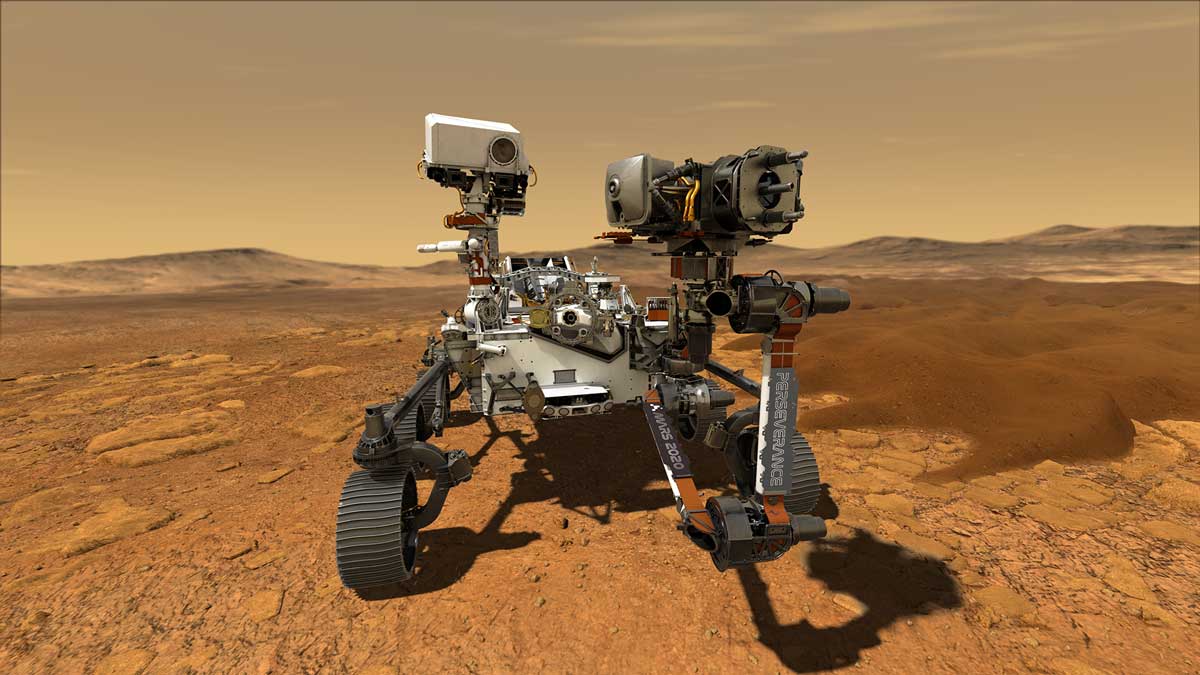
An illustration of the Perseverance rover. NASA/JPL-Caltech
Accompanying the two vehicles on this mission is an experimental piece of technology known as the Mars Oxygen In-Situ Resource Utilization Experiment, or MOXIE. The purpose of this instrument is to test out the possibilities of converting the Martian carbon dioxide atmosphere into oxygen for rocket propellant and potential breathable air for future explorers.
Of course, several other technologies are present on this mission that will undoubtedly further further our goals for the red planet in countless ways, but as of right now, we have a bit of a wait. Since its successful launch at the end of July, the mission is now in route to Mars with an expected arrival date of February 18, 2021. In the meantime, you can find updates on Perseverance’s status on the mission website (where, after arriving on Mars, raw and processed images will be available to view as well) and follow along with it on the Twitter feeds for the Perseverance rover (@NASAPersevere) and NASA’s Mars programs (@NASAMars).
Follow @TwinCitiesGeeks on Twitter or Like Twin Cities Geek on Facebook for more great stuff from Minnesota geeks in your feed!
About the Author

Joe Praska
Joe is an elementary-school teacher in Minneapolis with a particular excitement for teaching science. He began to dabble in writing and blogging in 2013 and has spiraled further and further down the rabbit hole ever since.


