
Axiom Verge 2 Is Another Unique Entry in a Crowded Genre
Axiom Verge was a Metroidvania game that I loved for its unique spin on a classic genre. Though clearly influenced by Metroid, the way it allowed players to mess with the assembly of levels was a new way to explore that I had never seen before. The genre is defined by a large map that the player gradually explores as they unlock new abilities. In most, this is accomplished with double jumps and wall climbs, but Axiom Verge lets the player clip through walls and dismantle in-game objects. It was characterized by a uniqueness that comes from a single creator, and in fact, creator Thomas Happ did everything from the coding to the music. I’m thrilled to see that his talent has not diminished in the slightest, and Axiom Verge 2 is engaging, unique, and worth your time.
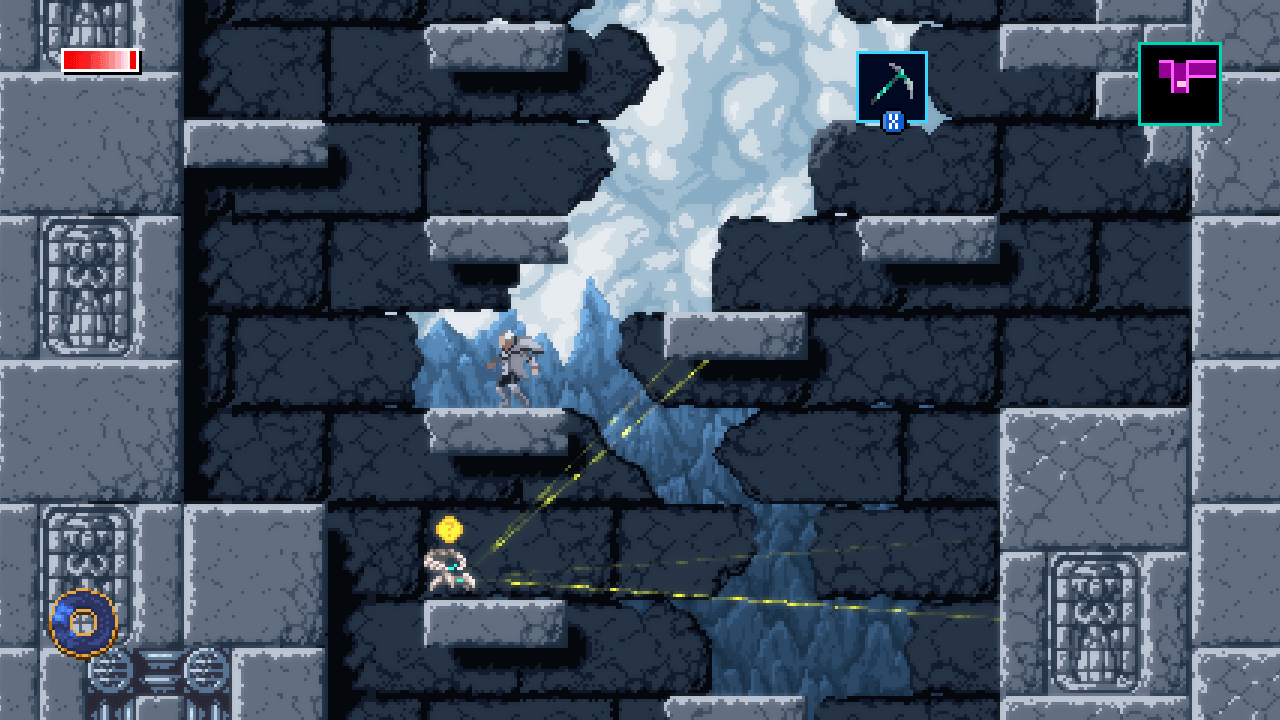
Exploration is the meat of the game in Axiom Verge 2. Nintendo
While most games in this crowded genre focus on combat, Axiom Verge 2 is about exploration. In fact, combat is pretty simple, as it’s centered around swinging a pickaxe and throwing a boomerang. There’s not a ton to it, and combined with the fact that enemies don’t drop anything useful, I tend to avoid it whenever I can. But it’s just one of several tools you have to safely pass through the obstacles. For example, one early ability allows you to hack machinery for a variety of uses, from opening doors to turning enemies to your side. The player is more equipped to creatively avoid obstacles than overpower them, though you’ll eventually be strong enough that overpowering them becomes an option as well.
Instead, the real meat of the game is finding creative ways to navigate the environment. The map is huge and packed with upgrades and secrets in every direction. There’s a feeling that something new is always around the corner, and the game does a good job of rewarding the player for exploring something new. It’s hard not to make progress and you can head anywhere you want. The steady progress and nonlinear exploration is an absolute triumph of map design.
However, in a game where you’re constantly getting new abilities that allow you to reexplore places you’ve already been, you’re going to do some backtracking. This is where the large levels and difficulty of navigation can be a hindrance. However, I expect the player will largely spend most of this time trying to digest the story. You play as the CEO of a company whose staff mysteriously went missing at an arctic research base. You head there yourself to get to the bottom of it and immediately get wrapped up in the history of an alien world. There are discoveries to be had about yourself, about the world, and even about how the sequel ties into the first one, and the player will have to put in some work to connect the dots. I for one liked the story, even if I’m not sure I understood it all, but I like my stories to have something to chew on.

The environments and pixel art are top-notch. Nintendo
Being unique doesn’t always mean good, and there are some who won’t enjoy the simple combat, or the occasionally opaque story, or the lonely walks through places you’ve already seen. But it’s an itch few games can really scratch. The Metroidvania genre is defined by exploring a place, by revisiting places and having new experiences. Few games nail the exploration side of that like Axiom. The steady stream of new information about the mysterious story and exciting mechanics to explore it make Axiom Verge 2 a worthy successor to an excellent game. Though definitely not for everyone, its uniqueness means there’s little else truly like it, and fans of the genre must play it to see the new possibilities for the genre.
Follow @TwinCitiesGeeks on Twitter or Like Twin Cities Geek on Facebook for more great stuff from Minnesota geeks in your feed!
About the Author

Hawkens Bory-Baar
Hawkens is a huge nerd living in Minneapolis with his partner and cat. He’s a FromSoft veteran, a weekly DM, and a mediocre Magic player.


