
An Introduction to the World of Custom Lightsabers
Ever since Star Wars debuted in movie theaters in 1977, kids have clamored for things to help them imagine being in the universe of a long time ago in a galaxy far, far away.
The original action figures and spaceships by Kenner were cool, but the one thing that I and many of my elementary-school classmates wanted was our own lightsaber. Kenner did make a toy lightsaber for kids to run around with, but the company’s first effort, I kid you not, was just an inflatable yellow vinyl tube attached to a flashlight. It was kind of sad looking, it wasn’t very bright, and it came with a patch kit because Kenner knew how durable these were not … and yet we still wanted them.
Lightsabers have come a long way since then. We’ve seen official models with retractable blades, some with sound effects, some that light up, and some that can do all of these. However, in the early 2000s, the company Master Replicas started producing much higher-quality lightsaber replicas. These were very popular among collectors and cosplayers because it was suddenly much easier to get a fairly accurate-looking prop. The current Hasbro Black Series Force FX lightsabers are directly descended from these sabers.

Hasbro Black Series lightsabers. Robert Atendido
However, these were not durable enough for things like dueling, and their sound and light effects were very basic. For fans looking to get a lightsaber today who want something more solid than the mass-produced plastic toys, but brighter and more feature laden than the Black Series sabers, there are many custom saber companies around the world.
These sabersmiths make a wide variety of hilts. For people who want something that looks like it came straight from the films, there are highly detailed prop replicas modeled directly on the screen-used items. Below are (left to right) one modeled after Luke’s saber in A New Hope, made by Korbanth and modified with some original Graflex parts; one modeled after Obi-Wan Kenobi’s, custom made by Darth Alice; and one inspired by Darth Vader’s, made by Vader’s Vault, with the hilt opened to show the dual kyber crystal chamber.

Lightsabers inspired by those used in Star Wars: A New Hope. Photos used with permission
If you don’t need a specific faithful replica from Star Wars canon, there are many other options available. The first hilt on the left below is inspired by the Darksaber, the second by the video game Borderlands. The third is a simple weathered black; the others are the Odin’s Wrath model from Jawa’s Junkyard and the Fury from Vader’s Vault, with intricate etching and mother-of-pearl inlay decorations.

Photo used with permission
Some people like to collect custom pieces to have on display or to use as costume props, and it’s possible to buy just the hilt with no electronics for these purposes. Of course, for the full Jedi or Sith experience, you will want to get your saber with installed soundboards and lighting systems.
There are two main types of blade lighting used in custom lightsabers: in-hilt and pixel. In-hilt, or base-lit, sabers have between one and four powerful LEDs installed into the hilt, which shine through a focusing lens into a hollow blade. This usually contains a plastic film and a mirror in the tip to help diffuse the light throughout the blade. This type of lightsaber is preferred by combat enthusiasts, such as members of the Saber Legion. Duelist usually use a simple saber with a single color and no sound effects, referred to by some makers as a “stunt” saber, because they are very sturdy and take impacts well. More complex features, such as RGB color changing and motion-activated sound effects, are available from most saber manufacturers as well.
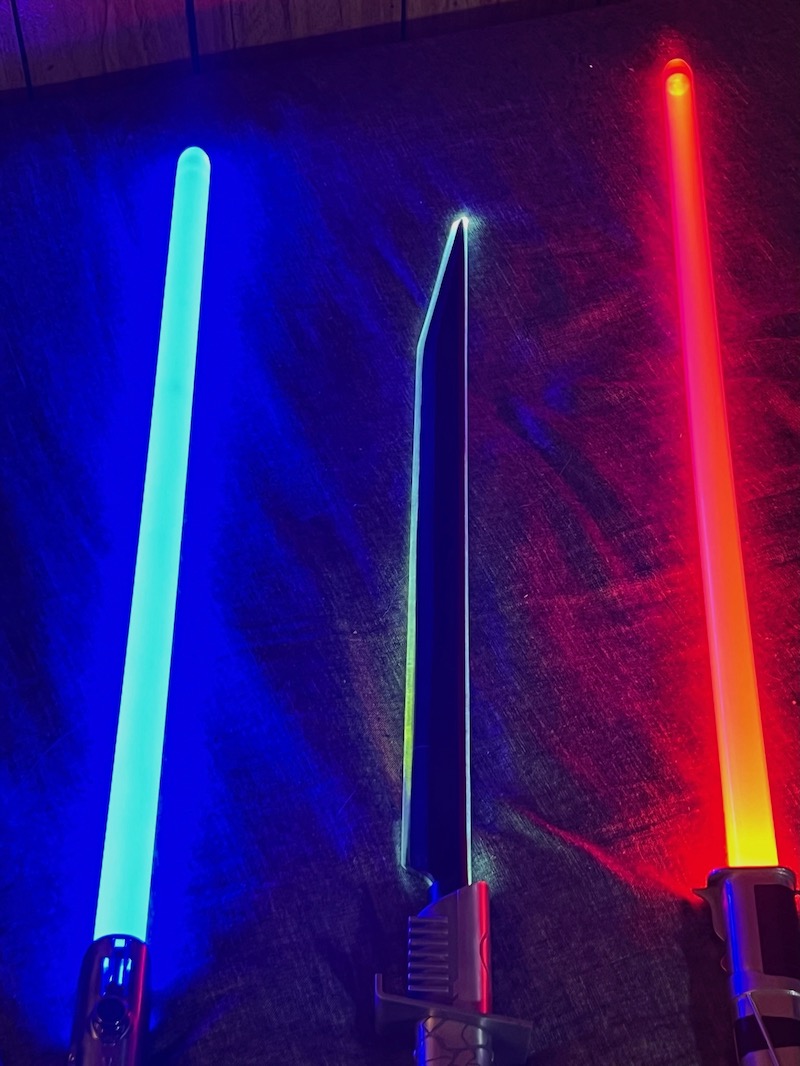
Left to right: Neopixel blade, base-lit Darksaber, base-lit Sith saber. Photo used with permission
If you want a saber that can do flashy blade effects, such as scrolling on and off or the unstable look of Kylo Ren’s blade, you need one with the LEDs installed within the blade itself. This type was actually used in the Star Wars sequel trilogy films and may be called by many names, such as LED string blade, pixel blade, Neopixel, or PlecterPixel (those last two being trade names from AdaFruit and Plecter Labs, respectively). In the higher-end pixel blades, each individual LED in the blade is controllable by a processor in the hilt (the soundboard) and can be programmed by the user for different light effects.
Among the most common lightsaber soundboards are Proffie, Crystal Focus X, Golden Harvest v3, Xenopixel, and Asteria, to name a few. The more complex boards can do many flashy light and sound effects but can be difficult to program, while the less complex boards have fewer customizable options but are simpler to program and less expensive. Sound effects may include the hum of an activated saber complete with smooth-swing motion-activated changes, blaster bolts being blocked, or the wielder using a Force push on their enemies. The higher-end boards allow the user to install their own sound effects, including music tracks that play while you’re wielding your saber. Most of these boards can drive in-hilt sabers as well, so you can have the fancy sound effects in any kind of saber. There are “sound fonts” inspired by just about everyone in Star Wars who has used a saber, but there are also sound fonts inspired by other sources.

SaberForge Neopixel blade showing color effects. Robert Atendido
If you are interested in buying a lightsaber, I highly recommend doing some research. There is at least one company out there, UltraSabers, that seems to spend a lot of money on internet advertising but little on improving its technology, which is years behind their competitors. For entry-level lightsabers, Chinese companies such as LGT mass produce low-budget but fairly decent quality sabers, available directly through AliExpress or from resellers around the world that provide more customer service. At the other end of the spectrum are companies that design and machine their own hilts from scratch. These companies produce a higher quality hilt that takes longer to get (mine took six months), although some of them have started selling ready-to-ship sabers which are not customizable.
Some good resources:
- The lightsabers subreddit has a good buyer’s guide, which goes into much more detail on saber technology and the more prominent companies, including who to avoid.
- SaberSourcing has custom saber news, reviews, and discussion.
- The Saber Legion has a lot of very good information on saber combat.
- For those who like the fancy saber-spinning moves that were introduced in the prequel trilogy, Michelle Christa Smith’s YouTube channel has a lot of tutorial videos.
As for me, you can find me with my custom lightsaber practicing my basic flow …

I’ve got a long way to go.
Follow @TwinCitiesGeeks on Twitter or Like Twin Cities Geek on Facebook for more great stuff from Minnesota geeks in your feed!
About the Author

Robert Atendido
Robert lived and worked in Japan in the 2000s and hopes to return someday—but only to visit. When not working at his day job, he takes part in a variety of hobbies, including historical reenacting, singing, swing dancing, and reminiscing about Japan.


