
Barbenheimer and the Legacy of Cinematic Double Features
Movies get paired together all the time. There’s the standard Hollywood counterprogramming, like when Happy Feet opened opposite Casino Royale. There’s accidental synergy, like when dueling magician films The Prestige and The Illusionist opened around the same time. Steven Spielberg regularly releases two films in a year, and they’re often linked in intriguing ways.
But there’s something unique about the relationship between Hayao Miyazaki’s My Neighbor Totoro and Isao Takahata’s Grave of the Fireflies. The founders of Studio Ghibli released both on April 16, 1988, as a double feature. My Neighbor Totoro became one of the most beloved children’s films of all time. Grave of the Fireflies became a confusing, disturbing experience for unsuspecting viewers looking for a film from the same studio.

GKids
Both films loom large in the mythology of their creators—keys to understanding what Miyazaki and Takahata hoped to achieve at the outset of their careers as self-employed artists—and they are most eloquent in relationship with each other. Each tells the story of a pair of children, alone in the rain in a moment of crisis. In Miyazaki’s fairy tale, siblings Satsuki and Mei are rescued by a benevolent flying spirit named Totoro. The children in Takahata’s film, inspired by history, are less fortunate. Fireflies is one of the most viscerally unsettling films I’ve ever seen. It left me physically ill. Totoro, meanwhile, offers an almost comedically hopeful answer to Jesus’s question “Who is your neighbor?” (a giant snuggly flying chipmunk who’s friends with a bus that can also fly and just wants to help me!). It makes perfect sense that one of these films has become something of a cult classic while the other gets referenced in Pixar movies.
And yet if you can muscle your way past the comparative pleasantness of viewing experiences, it becomes apparent both of their excesses are linked. Each story feels imbalanced on its own—too bleak, too gentle. Only together do they form a comprehensive vision of life: a fairy tale about all people might be, taken from the gentle, forgiving spirit of childhood; a heartrending nightmare about all we’ve been and can still be, taken directly from history. Two images in the periphery of every person’s awareness, depending on how hard they twist their head.

Warner Bros./Universal Studios
Thirty-five years later, audiences were treated to another double feature: Barbenheimer, the probably unintentional (though I have my theories) but nevertheless potent pairing of Greta Gerwig’s maximalist pink daydream Barbie and Christopher Nolan’s dour, partially black-and-white biopic Oppenheimer. Their shared success was easily the biggest film story of 2023. Of course, both filmmakers have had hits in the past, but only Nolan’s Batman films came near the success of this shared release (and, at least in Nolan’s case, many far more commercially promising films did worse with less competition). To date, Barbie has raked in more than $1.4 billion in ticket sales, while Oppenheimer hovers just a little below the billion mark—which, honestly, is even more impressive considering what the movie is about. Each seemed to make the other stronger.
You can blame it on the internet, but memeability is a historically wretched indicator of film success (just ask the creators of Snakes on a Plane or Morbius). Here’s my admittedly idealistic take: both films succeeded and continue to succeed because they struck a chord, because once you scratch away their superficial monochromatic qualities, they address similar anxieties that underlie modern life. Maybe some people were drawn to the theater by the opportunity to wear a half-pink, half-black suit, but they returned because the movies stirred them, reflected their dreams and apprehensions about the past, present, and future.
Studio Successes
Probably the closest historical corollary to Barbenheimer’s financial success happened on June 8, 1984, when Ghostbusters and Gremlins opened opposite each other to highly successful parallel runs. Ghostbusters was the obvious winner, remaining number one at the box office for seven weeks, but Gremlins also smashed expectations with a domestic run of almost $150 million dollars (more than $400 million in today’s money). Both of those films represented movements overtaking multiplexes at the time. Gremlins was the latest offering from the Spielberg/Amblin camp, known for playful, earnest adventure films like E.T., Back to the Future, and The Goonies. Ghostbusters was produced by Columbia, but everyone knew the talent and approach belonged to the comedy movement responsible for Saturday Night Live and National Lampoon.

Columbia/Warner Bros.
There is a familiar narrative surrounding the ’60s, ’70s, and ’80s in Hollywood. The studio era had collapsed under the weight of the counterculture and television, while youthful, ambiguous masterpieces like The Graduate, Easy Rider, and Bonnie and Clyde became huge hits. The studios, befuddled and desperate for cash, handed the reins over to younger, more artistically motivated filmmakers like Francis Ford Coppola and Martin Scorsese. Those filmmakers’ New Hollywood lumbered along for a decade or so, leaving flops and masterpieces aplenty in its wake. Then Jaws and Star Wars kicked the door in, and the studios breathed a heavy sigh of relief and went back to making mostly crowd pleasers.
That story is obviously incomplete and simplistic in ways that don’t pass the smell test, but this much holds true: for a period, the studios didn’t know how to make money, and out of desperation they handed a whole lot of money and power to some shockingly idealistic (straight, white, male) artists. Spielberg and Lucas came from those movie brats—it’s arguable their very popular blockbusters didn’t so much kill New Hollywood as salvage a few of its priorities when audiences inevitably scrambled for something more fun and comforting. But at that same moment, just down the hall, a generation of alt comedians and improvisers from Second City, the Groundlings, and more publicly Saturday Night Live and National Lampoon were also taking meetings about rebuilding studio comedy. The answer that stuck there was less high art than punk rock. The new generation had less faith in institutions than ever before, and a great many would pay to see whoever offended (aspects of) their parents’ sensibilities the hardest. Thus the raunchy, sardonic, admittedly poorly aged comedies like Animal House and Meatballs (the third and ninth best-selling films in their respective years).

Cillian Murphy in Oppenheimer. Universal Pictures
Both types of film became so saturated, their creators so successful, that by 1984 you could find Dan Akroyd, Bill Murray, and Harold Ramis in a Spielbergian supernatural adventure film releasing the same day as a dark, cynical sendup of middle America and holiday movie tropes under Spielberg’s Amblin banner. While the primary creative teams largely stayed the course (Spielberg only produced Gremlins; Bill Murray only agreed to Ghostbusters to get his passion project, The Razor’s Edge, produced) they had become so culturally ubiquitous that on one evening in the ’80s you could see two brand-new films that each tried to capitalize on each other’s success, and audiences clamored wildly for both. (If only there were a film-specific reference about streams crossing.)
Much like in the late ’60s, studios do not presently know how to make money. Streaming is not profitable. The superhero genre is finally collapsing. The studios thought they knew how they wanted to reorganize post–COVID lockdowns, but it turns out many of their ideas do not work. Every once in a while the narrative emerges that “maybe the movies are dead,” only for the obvious truth to emerge time and time again: the right movie in the right moment can still catch fire every bit as much as in 1997 or 1939. The movie theater remains the most accessible venue for immersive storytelling anywhere in the world, and immersive storytelling will remain on the whole a pleasing, rewarding experience for most humans for the foreseeable future.

Paramount/Lionsgate
A Shared Ethos
Two filmmakers keenly aware of this admittedly idealistic, undeniably true fact are Christopher Nolan, one of a small handful of people on the planet who are blockbuster Hollywood brands unto themselves, and Greta Gerwig, well on her way to the same status, about to be nominated for best picture for the third time in six years. You could call either the obvious heir to Spielberg, but you might be doing the favor to Spielberg. When a cynic looks at Barbenheimer, they see the memes, the obvious disparity in style and approach, all the surface details. The first effort to replicate that success—September’s Saw Patrol—showcased that superficiality. (“You thought it was funny to see that happy toy movie and sad bomb movie together? Try this kids’ TV adaptation and some torture porn! How quirky!”) But the true secret ingredient might just be the shared ethos of Barbie‘s and Oppenheimer‘s primary creatives, who were determined to tell personal, atypical stories in languages accessible to a majority of the moviegoing public.
Take Barbie. If you isolate the story from all the musical numbers and anarchic action set pieces, it feels every bit as allegorically personal as Gerwig’s Lady Bird and Little Women. Margot Robbie’s Barbie feels like an American white millennial avatar, growing up in a bubble, believing all the propaganda sold to her, only to head out into the real world and have all those comforting notions smashed. She spends some time as Depression Barbie, wearing sweatpants and watching the BBC’s Pride and Prejudice on repeat, before accepting the challenge and teaming up with other Barbies to make the world more like she once hoped it might be. I personally find it very relatable. She also struggles to balance her awareness of the world with her own identity as an individual, feeling person. Again, relatable.

Lara Cornell/Warner Bros.
The conflicts that defined J. Robert Oppenheimer’s life—between the right and left, between science and the military-industrial complex, between conscience and state-imposed fear—also remain, unfortunately, as relevant now as they were 80 years ago. Where Barbie looks at the present and imagines a future through fairy tale, Oppenheimer looks at the past through a seemingly triumphant Hollywood biopic that gets hijacked midway through by failure and horror. This essay is already too long, but my short response to criticism of the film is that criticism is part of what makes art so vital to the world. I can only speak to my personal experience, which is that I think Oppenheimer addresses many of its critics’ concerns more vividly and effectively than most war films with higher on-screen body counts. President Truman brags about his slaughter. US soldiers joke about having their opponents executed. One US official crosses Kyoto off a list of possible bomb sites because he and his wife vacation there. Oppenheimer, as played by Cillian Murphy, is frequently cowed by fear, shivering and sullen as he fails so many tests of his courage and morality. He sells his gift to the state and immediately sees it used in the most horrific manner imaginable. He gets swept up in his self-mythologizing but, in the end, finds he hasn’t so much forged a consensus as coerced the scientific community into helping the military, a favor the cynical and power hungry have no intention of returning.
I would need to spend many more words to explore all the merits and shortcomings of auteur theory, but I think both Barbie and Oppenheimer demonstrate one major advantage of emphasizing a singular voice during production. They are uniquely stylized, eschewing CGI in many places for gloriously rendered physical sets and practical effects, and including meditative, standalone character moments that would not survive the typical studio production process. When the artist has an outsized say in production, it can mean more specific and surprising choices. Audiences, tired of the generic and predictable, with evolving tastes shaped by the Promethean mixed bag that is the internet, see that difference.
The Human Element
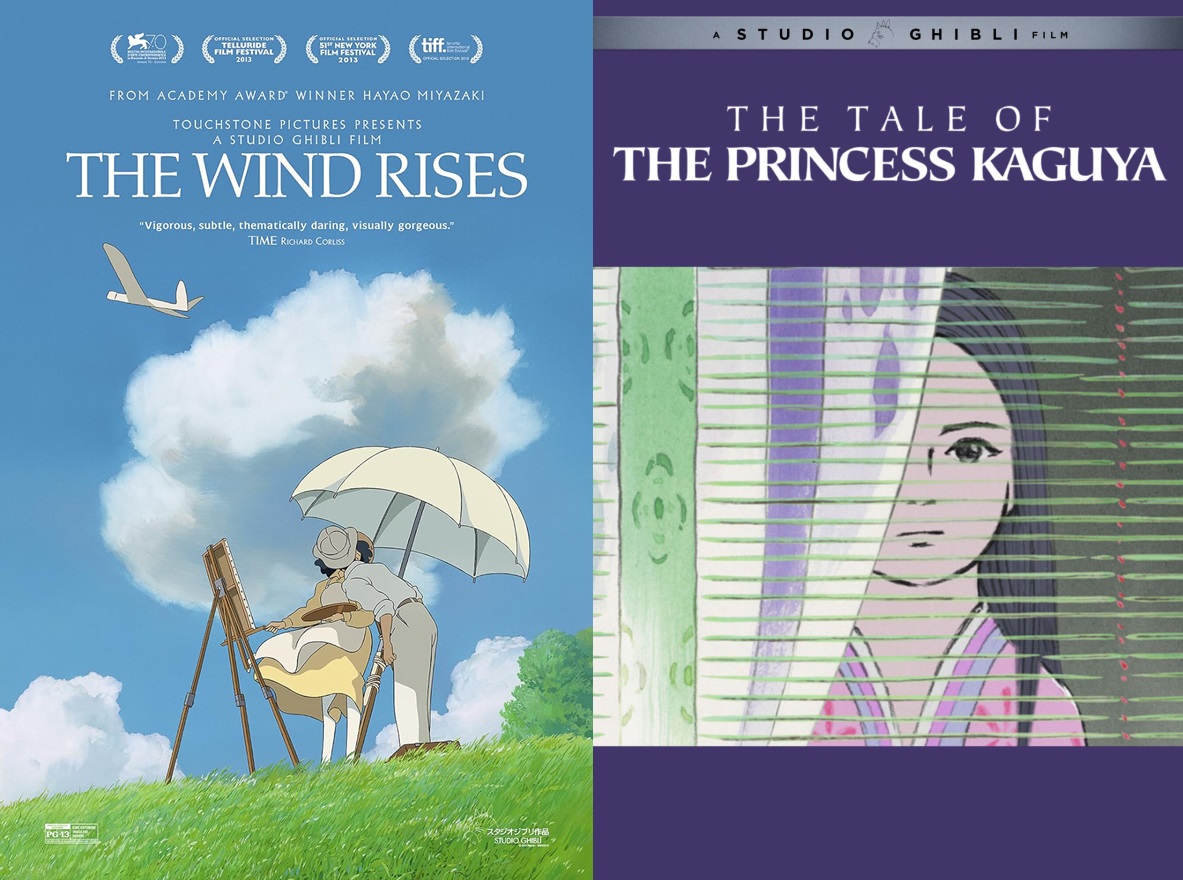
Gerwig and Nolan both have long track records of treating their time with the audience like it matters—like when we all meet together for a couple hours of focus in a dark room, there are genuinely urgent matters to discuss. They share this conviction with artists like Miyazaki and Takahata, who intended to release another double feature 25 years after their first. Ultimately The Wind Rises and The Tale of the Princess Kaguya would be released several months apart, but I believe they were still in dialogue with each other the same way as Totoro and Fireflies.
This time it was Miyazaki who told a story from history, about Jirō Horikoshi, a dreamer whose great engineering skill was used by the Japanese war machine to produce kamikaze planes. Takahata went with a 10th-century Japanese folktale about a young woman gifted by the moon to a family of farmers. Takahata’s film is similarly bleak, although he finds some hope in a song passed from mother to daughter, a legacy of emotional connection passed on primarily by women and growing in strength with each generation. Both intended their films as swan songs. (Takahata died in 2018; Miyazaki would ultimately come out of retirement to release The Boy and the Heron in 2023.)
Where their 1988 pairing was linked by the question “Who is your neighbor?,” the 2013 releases united around “What did it all mean?” Each film includes a scene in which its hero more or less answers that question, and both Jirō and Princess Kaguya insist life remains beautiful and worthwhile thanks to love, friendship, and interpersonal decency. But there’s also a weight, a terror, a deep pessimism about the larger project of society and its many costs.
GKIDS
Barbie and Oppenheimer also feature heroes who want to make a better world. Robbie’s Barbie is driven on her quest by thoughts of death, Murphy’s Oppenheimer by visions of an unstable universe. Both films refer euphemistically to our present moment. Oppenheimer struggles to win over entrenched and cynical political opponents. Barbie watches in horror as what she once believed to be a progressive feminist utopia falls into the hands of cowboy-hat-wearing Kens waving American flags and passing ludicrous patriarchal laws. Both films include members of the establishment (including Will Ferrell’s Mattel exec and Matt Damon’s Leslie Groves) whose friendly dispositions evaporate under pressure. Groves abandons the scientific community the moment they give him his weapon of mass destruction; the Mattel executive shouts at Barbie to “Get in the box, you Jezebel!” and only later comes around to “average” dolls upon being told they will make money. Barbie finds a way to manifest a better future by speaking the truth to all the other Barbies, organizing and planning to take Barbieland back. Oppenheimer stares past the camera and states his opinion about his legacy and the legacy of men like him: “We thought we might start a chain reaction that would destroy the entire world. … I believe we did.”
The horror of what we know about the past, the beauty of what we can envision for the future, the origins of the nuclear age, and the plastic utopian promises that flourished in its wake—a picture too expansive for one single viewing experience, but two come closer. I was excited for Barbenheimer more than a year before its release because I loved its filmmakers, two rare examples of artists who keep finding ways to make personal, ambitious films within a highly restrictive studio system. Seeing them channel their anxieties, hopes, and observations (which in many cases mirrored my own) through distinct, crowd-pleasing genres made me hopeful for the future of my favorite medium.
By putting those anxieties at the forefront of the cultural consciousness, offering examples from history, envisioning a path forward (however whimsically) from the madness of our current moment, these films embody a shared ideal I’ll look for more ways to apply in the new year: we’ll get further and do more in dialogue together.
Follow @TwinCitiesGeeks on Twitter or Like Twin Cities Geek on Facebook for more great stuff from Minnesota geeks in your feed!
About the Author

Ryan Sanderson
Ryan is a carbon-based life form in the Sol system of the Milky Way galaxy. He likes Chinese food and Coen brothers movies.


