
Help Save the Bees with the Minnesota Bumble Bee Atlas
When bumblebees are in the headlines, it rarely seems to be good news. In recent years, we’ve heard that American bumblebee populations have declined by as much as 90 percent since 1990. While it may not impact the general flow of most of our day-to-day lives, this decline has a major impact not only on countless ecosystems but also on the pollination of crops and wildflowers integral to our food supply. Nationwide, about 25 percent of North American bumblebees are seeing significant population declines or risk of extinction. In Minnesota alone, 7 of our native 24 bumblebee species are currently considered at risk.
Fortunately, organizations like the Bumble Bee Atlas hope to positively shift the story through proactive research and community science.

Volunteers conducting a survey for the Bumble Bee Atlas. Phil Davies
The Bumble Bee Atlas is a community science project that operates nationwide and aims to track and conserve bumblebee populations. Our local chapter here in Minnesota began in 2016 and merged with the national Bumble Bee Atlas program in 2021. It now runs through a partnership between the University of Minnesota and the Xerces Society for Invertebrate Conservation.
Elise Bernstein, who works as a researcher and outreach specialist with the Minnesota Bumble Bee Atlas, explained, “We have divided up the state into 87 individual grid cells that volunteers adopt and survey for bumblebees two to three times between June and August.” The goal of these surveys is to provide documentation for scientists to get a better understanding of bumblebee needs in the state.
“Volunteers … conduct short habitat assessments,” Bernstein continued, “which include notes on observed management practices in the area, like mowing, grazing, burns, etc.; what flowers are blooming at the time of the survey; and weather information like temperature, percent of cloud cover, wind speed, etc.”
The data collected by volunteers over the past several years, Bernstein says, has helped advance conservation efforts nationwide by informing land managers on what practices are best for keeping up bumblebee habitats and giving us a better understanding of species’ abundance and floral preferences. Furthermore, community scientists participating in the program were the first to ever identify one of our 24 bumblebee species, the black-tailed bumblebee (Bombus melanopygus), in 2022 as well as provide the third ever observation of the rare Southern Plains bumblebee (Bombus fraternus) in Minnesota. For more information, you can find the local key observations and findings on the Minnesota project highlights page of the Bumble Bee Atlas website.
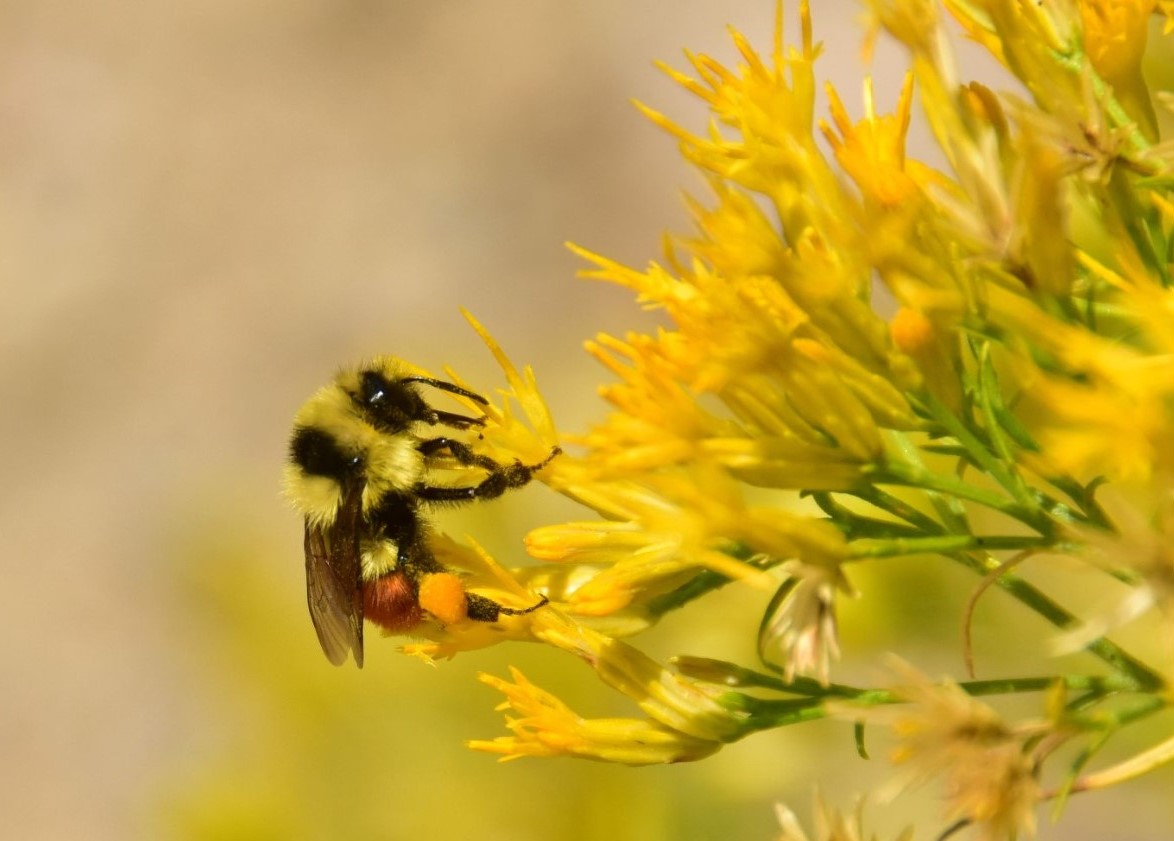
The Hunt’s bumblebee, one of the species found in Minnesota. Tom Koerner/US Fish and Wildlife Service
Even with all the positives this program has given scientists in the fight to preserve bumblebee populations, there’s still a lot of work to be done. Despite good coverage and documentation from the Twin Cities region and the southern part of the state from Bumble Bee Atlas volunteers, there are still gaps to be filled.
“There are several grid cells in the northwestern part of Minnesota that have historically been undersurveyed,” Bernstein said. “If you are thinking of adopting a grid cell, I highly recommend adopting one of the high-priority grids.”
And if joining the Bumble Bee Atlas isn’t in the cards for you, there are many other ways for all of us to support bee populations around us.
“One of the most important actions you can take to help bumblebees and other pollinators is plant flowers,” Bernstein advised. “A great goal is to have three different plant species blooming at all times from early summer to late fall. Creating habitat is another excellent step. Piles of leaves and dried grass can give bumble bees places to nest.”
The University of Minnesota has also unveiled Nest Quest, a different kind of participatory program that asks community science volunteers to adopt a potential bumblebee nesting site to visit and observe every other week.
“Even if you don’t formally adopt a grid cell,” Bernstein said, “you are still more than welcome to upload bumblebee photos as ‘incidental observations’ to BumbleBeeWatch.org. This data is still valuable, even when it isn’t part of a formal survey!”
Those interested in participating in the Bumble Bee Atlas program can expect to attend a training session, adopt a grid cell to visit throughout the summer, and conduct two or three 45-minute surveys. More information on how to sign up is available on the program website.
Follow @TwinCitiesGeeks on Twitter or Like Twin Cities Geek on Facebook for more great stuff from Minnesota geeks in your feed!
About the Author

Joe Praska
Joe is an elementary-school teacher in Minneapolis with a particular excitement for teaching science. He began to dabble in writing and blogging in 2013 and has spiraled further and further down the rabbit hole ever since.


