
“Fox Bunny Funny” Is Great Cartooning in Its Purest Form
First published in 2007 by Top Shelf Productions, Andy Hartzell’s graphic novel Fox Bunny Funny arrived amid the anxiety-soaked final years of the George W. Bush administration. An additional 20,000 US troops were “surging” into Iraq, the American housing bubble was about to burst, and the national backlash against marriage equality for same-sex couples was about to be codified—later to be overturned—by California’s Proposition 8.
Critics praised Hartzell’s wordless black-and-white fable for its crisp, clean design and unflinching exploration of identity and social control. Almost two decades later—amid record waves of anti-LGBTQ legislation, transphobic moral panic, and a systematic federal campaign to obliterate the constitutional rights of immigrants and refugees—the book reads less like a time capsule than a field guide. And it’s now available in a new deluxe edition from Minneapolis-based Uncivilized Books.

Courtesy of Uncivilized Books
Fox Bunny Funny is set in a binary world of anthropomorphic foxes and bunnies. As noted on the inside front cover, “The rules are simple: you’re either a fox or a bunny. Foxes oppress and devour, and bunnies suffer and die.”
It’s a gruesome proposition, made all the more arresting by Hartzell’s bold, inky blacks, distinctive silhouettes, and propulsive layouts. Over the course of three acts, the tone swings from slapstick to deadpan, horror to morality play, social commentary to fable—without a single word of text. The narrative follows a young fox whose sympathy for (and identification with) bunnies put him at odds with his rigidly binary culture. If you empathize at all with bunnies, it means you must hate foxes. And anti-fox behavior will not be tolerated.
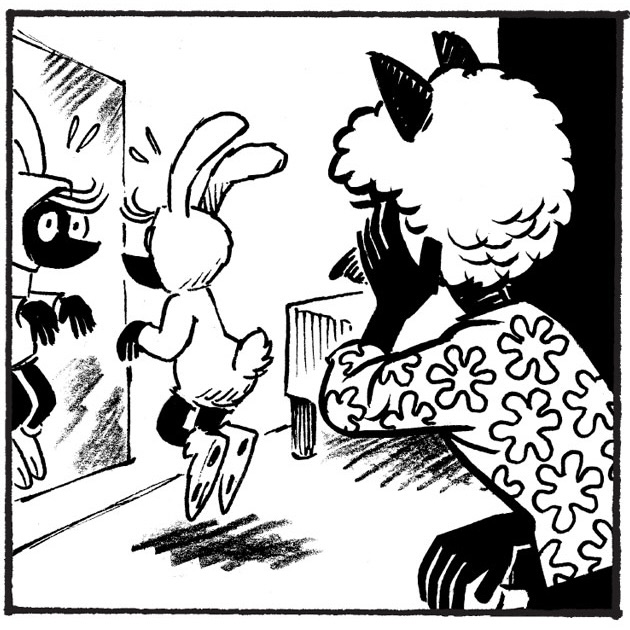
In the opening chapter, we follow the protagonist as an adolescent fox who chafes at his society’s norms, especially those that promote the ghastly act of hunting and eating bunnies. Away from his normative family, in the sanctuary of his bedroom, our “bunny-curious” protagonist explores his inner bunny identity. He dons a bunny costume and practices hopping in front of his mirror.
Courtesy of Uncivilized Books
A gossipy neighbor outs him. His mother confronts him. And he is sent to a reeducation camp to be “fixed.” There, he struggles to keep his identification with and affinity for bunnies hidden from his jingoistic peers and counselors.
Throughout the rest of the book, our protagonist does his best to suppress his forbidden desires and present as a culturally normative fox. Obviously, it’s confusing and exhausting to sustain an identity that undercuts who he truly is, behaving the prescribed way in public even as he longs for a world where foxes and bunnies coexist.
Eventually, our fox stumbles into a hidden city where foxes and bunnies live side by side—if not always harmoniously. It’s here, in a dazzling two-page spread, that Hartzell does what filmmakers and prose writers can’t, rendering a vast panorama that simultaneously illustrates multiple detailed expressions of power, desire, exoticization, and cross-cultural tension. It’s an ode to pluralism in all its messy, perhaps inherently fractious, multicultural glory.
The lack of dialogue, sound effects, and captions may be a bit disorienting at first, but soon you’ll be entranced by Hartzell’s accessible style. With a basic six-panel grid used throughout much of the story, the characters’ body language, facial expressions, actions, and reactions deftly convey the rather nuanced narrative.
Although the book’s fox/bunny iconography may superficially echo bad-faith species analogies sometimes used in anti-trans and racist rhetoric, Hartzell’s wordless tale deliberately resists mapping neatly onto any single issue. It’s a book that rewards rereading, revealing subtle details and ironic juxtapositions upon closer examination. The clean, silent cartooning conveys a potent allegory about the effects of coerced conformity on desire and self-expression. Can multiple distinct groups with different value systems, worldviews, and identities coexist within the same society or system? Is it possible to live in a society where no single culture dominates and is prized above the rest?

Courtesy of Uncivilized Books
Hartzell doesn’t give us the answers. The architecture of exclusion is not some lingering relic; it’s encoded in our constitution and further reified by our laws, cultural norms, and institutions. Hartzell underscores this point, weaving an enthralling tale about identity and belonging while leaving space for more exploration.
The “Almost-20th Anniversary Edition” of Fox Bunny Funny from Uncivilized Books comes with an alternate ending and a bonus story about the meteoric rise and tragic fall of Yip the Wonder Dog. It’s available now at your local comics shop or independent bookstore or through the publisher’s website.

Courtesy of Uncivilized Books
Follow @TwinCitiesGeeks on Twitter or Like Twin Cities Geek on Facebook for more great stuff from Minnesota geeks in your feed!
About the Author

John Schaidler
John is a Minneapolis-based writer, photographer, and educator who believes in the power of stories to foster empathy, inclusion, and cross-cultural connection. He helps young writers find their voice and believes narrative builds community.


