
Get to Know Minneapolis Queer Cartoonist Archie Bongiovanni
Archie Bongiovanni, whose work includes the webcomic Grease Bats and the critically acclaimed A Quick and Easy Guide to They/Them Pronouns, is originally from Alaska but has lived in Minneapolis for over a decade. Their lifelong love of comics and visual storytelling brought them to the Minneapolis College of Art and Design to study comic art.
Bongiovanni currently works as a sexual health educator in addition to writing and drawing comics for independent publication as well as websites such as Autostraddle and the Nib. Their creations center on the dynamic and, at times, messy lives of LGBTQA+ people. Their life in the Twin Cities has reflected that weirdness in a way that showcases the humanity of queer people and the love that Bongiovanni has for their community.
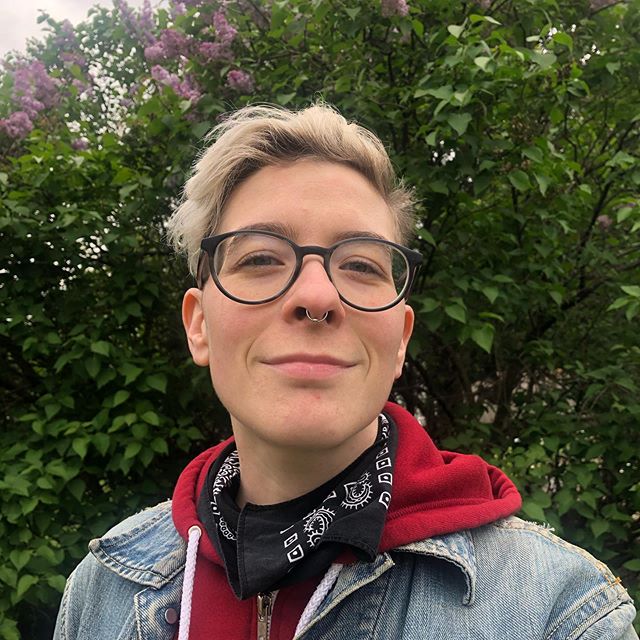
Janice Renoux (TCG): What motivated you to focus your work specifically on the queer community?
Archie Bongiovanni: Basically, it’s what I was surrounded in; it was a way to tell the stories about me and my pals. It wasn’t even a thing I thought about or questioned. I want to draw things that feel kind of familiar, things that I’m a part of. And by drawing comics, it’s really allowed me to explore my feelings about certain things, events, in a way that feels a step removed from my own life. It’s my characters experiencing—not me directly. It wasn’t even a really conscious thought to focus on queer things; it was just like, I was going to draw from my experience. And it just kind of enveloped everything I do.
TCG: Is there anything you think about the perspective of being a nonbinary creator or telling the stories of nonbinary characters that is unique from a storytelling perspective, as opposed to characters or storytellers who might be on the gender binary?
Archie: The only thing I’ve really had to think about was when I very first started drawing nonbinary characters, which was five or six years ago—when my comic Grease Bats went up on Autostraddle, which is a clear feminist website. When I first started drawing it, I was very concerned that people weren’t going to know what was happening or that people were going to read it and be, like, confused? Even though there are a lot of people who use they/them pronouns and identify as nonbinary, I was still a little unsure about how folks were going to interpret it. They weren’t [confused], and it ended up being just fine.
TCG: You’ve resided in the Twin Cities, which is one of the gayest metro areas in the country, for some time now. How has your life in Minneapolis influenced the art you create?
Archie: I think Minneapolis has been a big-ish influence in my art because I love the city. It’s such a thriving city, it’s such a busy city, but it’s also a small enough city that if you want something, you can make it happen.
When I first came out, I was having a hard time finding community and friends. I was able to start a queer book club, and I was like, “Hey, this is actually easy.” And I was able to organize queer dance nights. There’s all this queer theater. Just such variety in Minneapolis. For what’s going on and whatever your interests might be, it was really easy to participate in a lot of different areas under a queer umbrella. And I think that variety has bettered my work: what is happening within Minneapolis and our queer community has also influenced my work in that things that happen here will directly happen in my comics as well.
TCG: Do you find yourself writing comics based primarily on your personal experiences, or do you draw from wider sources of inspiration, like other queer people that you meet or stories that you’ve heard?
Archie: I like to think that my comics are things that have definitely directly happened to me, but it is a lot broader than that. I will get inspiration from conversations that I have with my friends, or something that someone I know [is] going through will kind of reflect itself back into my comics. When it comes to my comic Grease Bats, that’s important to do because there’s different characters with five different experiences, and it’s not just me.

From Grease Bats. Autostraddle
TCG: Have you ever experienced, seen, or heard something affecting the queer community that really made you think that this is something we need to talk about, this is something that I want to make sure people see in my work?
Archie: Yeah. I think my comics vary. I have drawn about the closing of queer spaces—that is something I think has happened in Minneapolis, where our actual physical buildings will pop up and close down. So I’ve drawn about the end of the Town House in St. Paul, which is now the Black Hart, a soccer bar. I’ve drawn stuff like that, and then the rest of it is a little bit more broad, about whatever conversations might be popping up in my community.
TCG: You’ve previously commented on wanting to reflect the nuances, imperfections, and weirdness of the queer community, especially with your work in Grease Bats. What sort of challenges have you identified in creating content that you feel is genuinely reflective of the queer community?
Archie: I think it’s hard to not make your characters perfect. Also, to separate your opinions and your actions from your characters. Because I want them to fuck up, because the characters are going to fuck up in the way that humans do, where we’re imperfect, and we say the wrong things and we do the wrong things. There’s a little bit of pressure to have characters that are “good” and not necessarily messy.
And I think that’s a kind of thing: I’ve always wanted to draw kind of sloppy characters and I continue to do so, but it is always nerve-racking to make them too sloppy, too wrong on a topic. And I think that’s at the base of what happens in my stories. A character will have an opinion, and they’ll talk about it with their friends, and their perspective grows.
TCG: Nonbinary people in particular are regularly exhausted with being asked for explanations about themselves and their experiences. Was it that kind of frustration that motivated A Quick and Easy Guide to They/Them Pronouns?
Archie: Oh yeah, 100 percent. A Quick and Easy Guide to They/Them Pronouns actually started as a zine a number of years ago, before I had published anything—because zines are cheap, they’re easy to produce, and they’re very accessible. So I had gotten really tired of explaining they/them pronouns, how to use they/them pronouns. So I teamed up with my pal Tristan, who’s the coauthor of the book, to make this zine, which was at the time called A Cheap and Easy Guide to They/Them Pronouns, and it was three dollars. And it was, like, “Here’s how you should do it, here’s why you should do it.”
I made that zine for a number of years, and it had sold really well; it was very popular. It ended up on an editor’s desk, and they contacted me and said, “Do you want to expand this?” But I had to get rid of all the drinking references and the swearing. And I was like, yeah, I think we can put that together.
It ended up being a little bit longer, and in the updated book version we really wanted to have a little bit of focus on work inclusion and how to create a good environment in different workspaces, as well as talking about what to do if someone doesn’t respect your pronouns. Kind of picking and choosing your battles, ’cause I think that’s kind of a big part of it: when to stay and when to walk away from a person.

From A Quick and Easy Guide to They/Them Pronouns. Limerence Press
TCG: Do you have plans to continue producing nonfiction work in the future?
Archie: I do. I love fiction work, but I also really enjoy producing nonfiction. It just feels like a lot more work because there’s so much research, and you really want to be super thoughtful. I have a project that I can’t announce yet that is going to be a mix of fiction and nonfiction that is going to start to be in the works soon, and I’m working on another comic with the Nib. I’m illustrating some stories, so that should be up soon, too.
TCG: What do you think it is about drawing and writing comics that conveys your content or your stories better than other media—like, say, writing a book?
Archie: So I am a big advocate that you can’t have too much information. I love that there are books out there that are about genderqueer identities, about being nonbinary, about using they/them pronouns. I like that there are comics about it, like mine, that are eight dollars and affordable that you can give and have physically in your hand. I love that there are webcomics, and I love that there are blog posts about it.
Each type of media is going to be accessible to a different type of person. We all have different learning styles, we all have different ways that we want things to be explained. Someone might want a very academic point of view, and someone else is going to want a very nonacademic point of view. And I don’t really believe that there’s anything in the queer community that’s been oversaturated yet. The more ways for folks to learn, and the more types of media, the better it is for everyone.
TCG: Web-based publishing—especially for comic artists—is considered one of the more accessible ways to get your work out there, but do you see any kind of advantages or disadvantages to web content beyond the accessibility factor?
Archie: One of the disadvantages for having stuff online is that it usually doesn’t also pay very well. I think that’s one of the downsides to having something online. I think we’ve grown up in a society that at this point in our lives, where so much of the internet has been free and accessible—and that’s super awesome and very important—it’s really hard when you’re also trying to have it be your livelihood. And having folks realize that comics are valuable and, you know, deserve to be on the web, and people deserve to be paid for drawing and creating it, I think it’s a little bit harder for folks to recognize.
I think that’s changing now, especially with a lot of media platforms shut down, or their comic areas dissolved into video or something like that. I think that’s the hard part of having a comic online. It’s because it’s accessible that you can get a lot of readers and followers and that way to share your work that I think is totally awesome. I think the downside is where getting paid for your work comes in often.
TCG: The art style that you use in most of your work seems to emphasize dialogue and interaction over spectacle. Is this a natural growth of your style, or were you more intentional in developing the art style you use these days?
Archie: I don’t know if anything I do is super intentional. I think I’m a very reactionary person. But I think that it’s just how I experience stories and how I experience storytelling in that it’s very dialogue focused. It’s not a lot of action. I don’t think I’ve drawn someone jumping in a long—like, ever.
But that’s kind of how I communicate, and the basis of my stories is the dialogue, it’s the people talking, because I feel like that’s honestly the most interesting. And when I personally read comics, that’s what I’m drawn to. I care so much about what’s being said and how people are saying it and the voices, the characters that are being written, more than an action sequence.

Grease Bats, Autostraddle
TCG: Are there any other media that you think you’d be interested in branching out into in the near future?
Archie: I’ve been doing a lot of illustration work, which is not that different from comics, and that’s been really fun. I have a desire to do games. I printed a game myself, which is very annoying to print and very expensive. But it’s very queer focused, and it’s something that doesn’t really exist right now. Like I said, during the day I’m a sexual health educator, so I like bringing that aspect into my work as well. I have no real desire to learn animation. I’m working on art prints, and I like to write, too. So, yes, a written book or a written chapbook or a poetry book is in my future.
TCG: Are there any particular artists or writers you would cite as inspiration or role models for your work?
Archie: Alison Bechdel is amazing, and I think everyone kind of knows who she is. I find myself drawn to illustrators and comic artists. With that being said, I love the Woman World comic, if you’ve heard of that. It started on, I think, Instagram and then got published as a book. It’s so smart and so fun and accessible. I’m also a fan of an artist named Alyssa Andrews—who is also my partner, but they also inspire me a lot, too. They draw a queer angle and a disability angle and where the intersections of those meet, and I get a lot of inspiration from them, too.
TCG: It’s pretty difficult for a lot of queer people to break into creating professionally, and for stories about explicitly nonbinary folx to be seen. Do you have any recommendations or advice for an aspiring queer creator who’s looking to break into comics or get their work published?
Archie: Yes, a couple different things. One, get a day job. Comics has never been my main source of income. Luckily, that might change at some point, but it’s also nice to have something reliable, so I think that’s worthwhile. And kind of a realistic expectation to put on yourself. ’Cause you’ll feel really crummy about where you are in life if you’re thinking, “Why am I not making my income on comics?” These comics cost, like, 10 bucks. It’s not wholly realistic. So, realistic expectations.
Two, I think a thing that’s hard for a lot of comic artists is actually finishing a project. So I think there’s a lot of value, and an artist can get a lot of value out of completing a project and sharing it, and to have smaller projects that you can finish. It is awesome to see a long, ongoing story, but it’s also really nice to have something small that people can purchase and take home with them and read on their own.
And as far as actually making money on comics, if you go to a comic con or a zine fest, you meet the people that are creating income based on their art even if it’s not their sole source of income. That can be really helpful. I know at CAKE, recently—the Chicago Alternative Comics Expo—there was a workshop on the business of comics by a person named Isabella Rotman, and I think seeking out other professionals and festivals where there are things on that topic is good. Because the way I do it is very different from the way someone else might do it.
TCG: You’re a sexual health educator for your day job, and of course you work in comics. Do you find yourself doing anything particular in your free time when you’re not drawing or writing?
Archie: Oh my gosh, trying to relax. Honestly, with comics, having more than one job is so time consuming. But I think it’s super important to be a well-rounded person with a multitude of interests. I’m also very invested in the queer community here. So when I’m not working—for a while last summer, I was organizing queer dance night called Daddy with a pal, and that was super fun. And it was just nice to do something that had nothing to do with my other jobs. So I think I’m going to step back up with that in some different aspect soon. Otherwise, I try to hang out with my friends as much as possible, ’cause they’re the ones that make my characters not just me over and over again.
TCG: Any closing thoughts?
Archie: Keep an eye out for Grease Bats, which will be released [in print] in September. I plan to have a book release party, at least one or two of them, so keep an eye out for them; they’ll be local to Minneapolis.
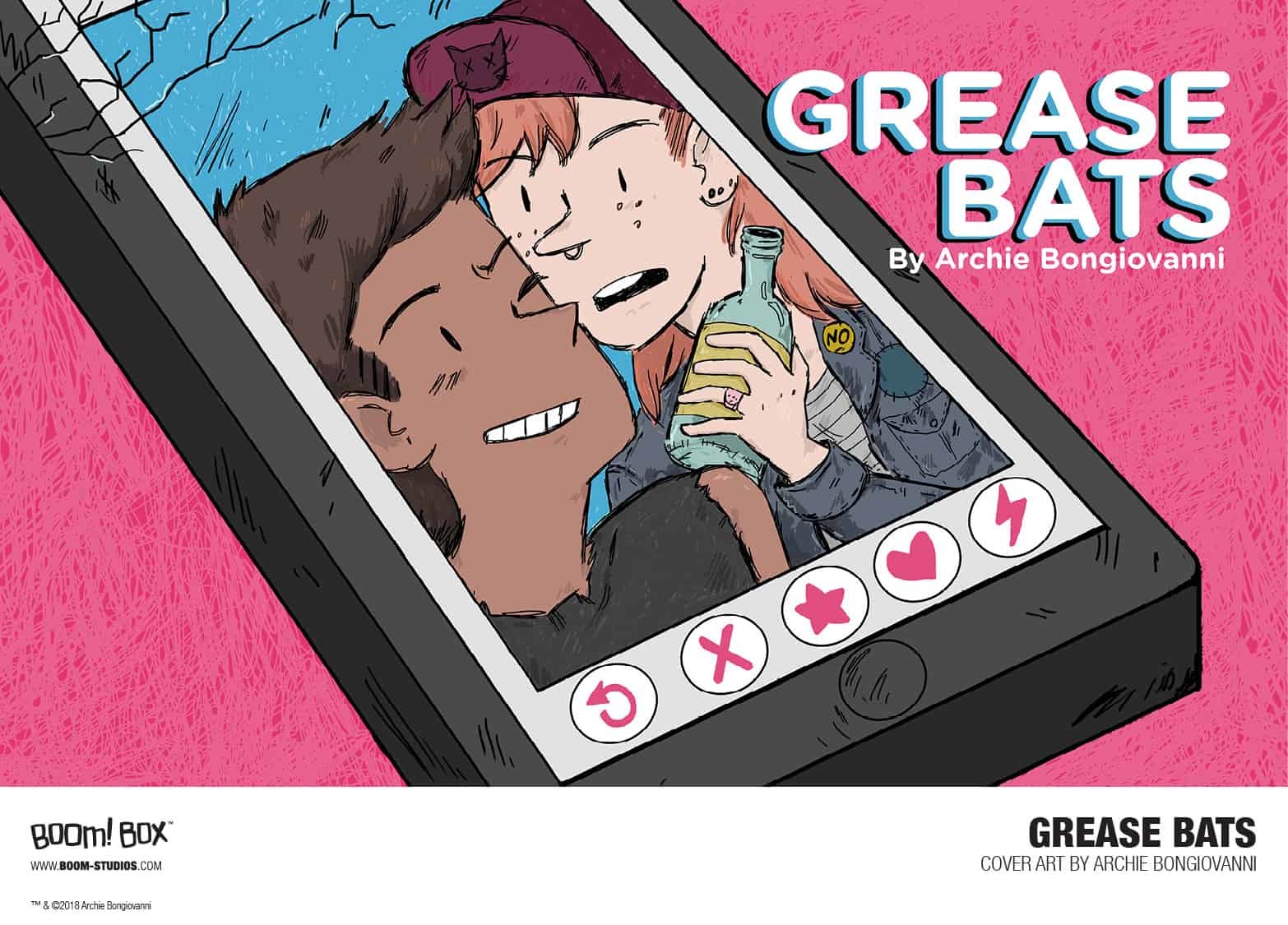
BOOM! Studios
Grease Bats will be out from BOOM! Studios on August 28, 2019. You can pick up a copy of A Quick and Easy Guide to They/Them Pronouns from Powell’s Books or check with your local independent retailer of comics and queer literature.
You can find Archie Bongiovanni’s work on their website or on Autostraddle and the Nib and follow them on Twitter and Instagram. If you want to support their work, consider becoming a supporter of their Patreon.
Follow @TwinCitiesGeeks on Twitter or Like Twin Cities Geek on Facebook for more great stuff from Minnesota geeks in your feed!
About the Author

Janice Renoux
Janice is a Twin Cities–based writer whose existence is neither confirmed nor denied by the United States government. They regularly meet or exceed expectations.


