
Postcards for a Songbird Comes Up Short as a Character-Driven Story
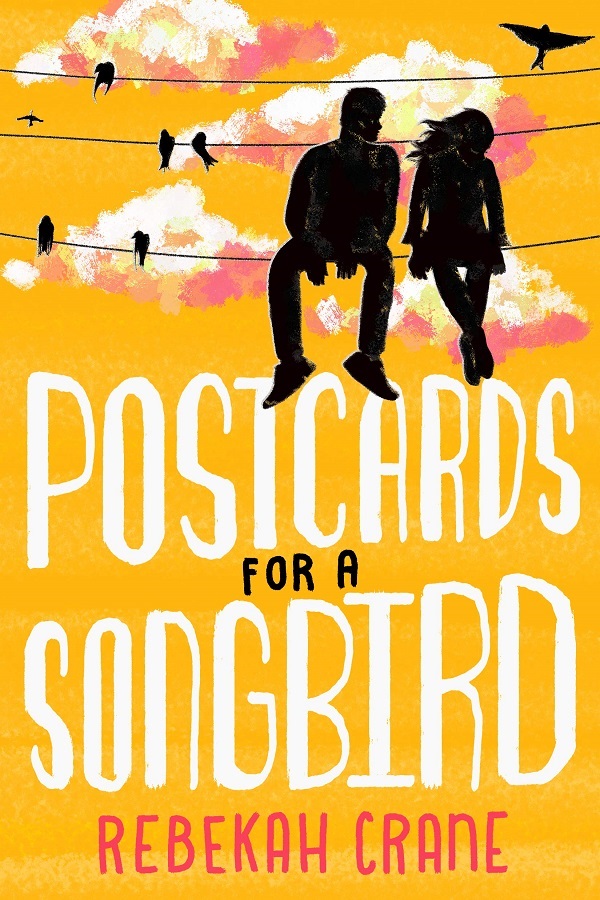
Skyscape/Amazon Publishing
I admit that I have very simple expectations when it comes to contemporary YA novels. I’m not looking for a big, sweeping epic or an action-packed road trip; for me, the quieter, character-driven stories that focus on the complicated relationships we have with others are the ones that I remember and love the most. I thought that was exactly what Rebekah Crane’s latest book was going to give me. Unfortunately, I got something completely different from this book—and I’m still not quite sure what that something is.
Postcards for a Songbird is the story of Wren Plumley, a shy teen deathly afraid of abandonment. Lizzie, her eccentric older sister, disappears one day, leaving Wren to live with their harried, overprotective single father. Eventually Wren opens up and make friends in Lizzie’s absence, and she begins to fall in love with Luca, a boy in her driver’s ed class; it’s then that Wren must make the decision to spread her wings and take the risk of getting hurt—or stay in her head and never take any chances at all.
Because there isn’t much in the way of plot, the characters are what drive this story, and it disappointed me that I didn’t care about any of them. Lizzie in particular never made much sense to me because of the manic pixie vibes she was constantly giving off. She’s older than Wren, but her behavior makes her seem much younger than she is. Her free-spirited nature and insistence that beauty exists in everything gets to be grating before the first chapter is even over, and it’s made even worse when she begins to romanticize serious things like physical abuse. The function of a Manic Pixie Dream Girl is usually to change the life of a male character, but Lizzie serves a similar purposes for her sister; while I do appreciate the slight variation on the trope, it doesn’t change the fact that it’s still played straight. Lizzie has no goals of her own outside of being a source of stability for Wren, and her dialogue is so flowery and unrealistic for a teenager it made me roll my eyes constantly while reading.
Luca, Wren’s love interest, is another weak point in the story. He and Wren share an insta-love moment at the supermarket when he runs into her with his skateboard, and they sit next to each other in driver’s ed. Wren is hesitant to let him in, but Luca is constantly harassing her to go out with him, making uncomfortable jokes and refusing to give up until she says yes. It’s revealed later on that he’s not a terrible person, but his behavior concerning Wren is appalling and not romantic in the slightest. They share nothing in common, making their romance feel shallow and their attraction surface level—especially since they find each other mutually attractive and repeatedly say so, as if I needed it as further confirmation that their love is valid.
The other characters don’t serve much purpose outside of taking up space with their two-dimensional personalities. Leia, Luca’s coworker at the supermarket, forcefully spouts facts about how processed food causes cancer and is generally abrasive to everyone she meets. Chief, Wren’s father, is overworked and trying his best to raise two girls on his own, but he’s not particularly interesting, and his overprotective nature doesn’t make him likable. Wilder, an ill teen who doesn’t leave the house where he lives next door, seems like a potential second love interest to Wren, and for a while I thought the book was going to take an Everything, Everything turn. Nothing substantial is done with Wilder, however, and his ultimate purpose left me confused and slightly irritated.
Wren, at the very least, goes through a character arc of sorts, realizing she needs to be more like her sister and leave the nest, so to speak. Her actions become more bold and more reckless, and her attitude does a 180 seemingly out of nowhere. Character arcs are supposed to be gradual and satisfying, and Wren’s just doesn’t fit the bill. It doesn’t help that the story is told over the course of a single summer but often skips over huge chunks of time and and favors flashbacks to Wren’s interactions with Lizzie. It’s clear that Wren needs to be brave and not shut the world out, but the message is forced, disingenuous, and certainly not earned.
I was hoping Postcards for a Songbird would be a new favorite YA contemporary of mine, and I tried hard to enjoy myself despite the obvious flaws. But those flaws are just too hard to ignore. While it was a quick read, it wasn’t fun, and it wasn’t anything I’d recommend. There are far better character-driven books that involve a main character stepping out of their comfort zone and learning to let others in—books with well-rounded characters and satisfying conclusions. I never like being this negative, but I definitely give this one a hard pass.
Postcards for a Songbird is out August 6, 2019.
Follow @TwinCitiesGeeks on Twitter or Like Twin Cities Geek on Facebook for more great stuff from Minnesota geeks in your feed!
About the Author

Hannah Testa
Hannah hails from Edina and is currently buried under a pile of unread books. Her hobbies include Funko POP! collecting, spending hours at a time at the library, and watching terrible Lifetime movies. She’s working on her first YA novel.


