
Network Effect, the Fifth Book in the Murderbot Diaries Series, Is Irreverent in the Best Way
Network Effect is the newest installation in Martha Wells’s series now known as the Murderbot Diaries. The first four Diaries are a series of novellas, beginning with All Systems Red, which won both Hugo and Nebula Awards for Best Novella in 2018. All the novellas are available in trade paperback or e-book from Tor Books. Network Effect was released, also from Tor, in May 2020, and it is the first full-length novel in the series, though it continues the story told in the novellas.
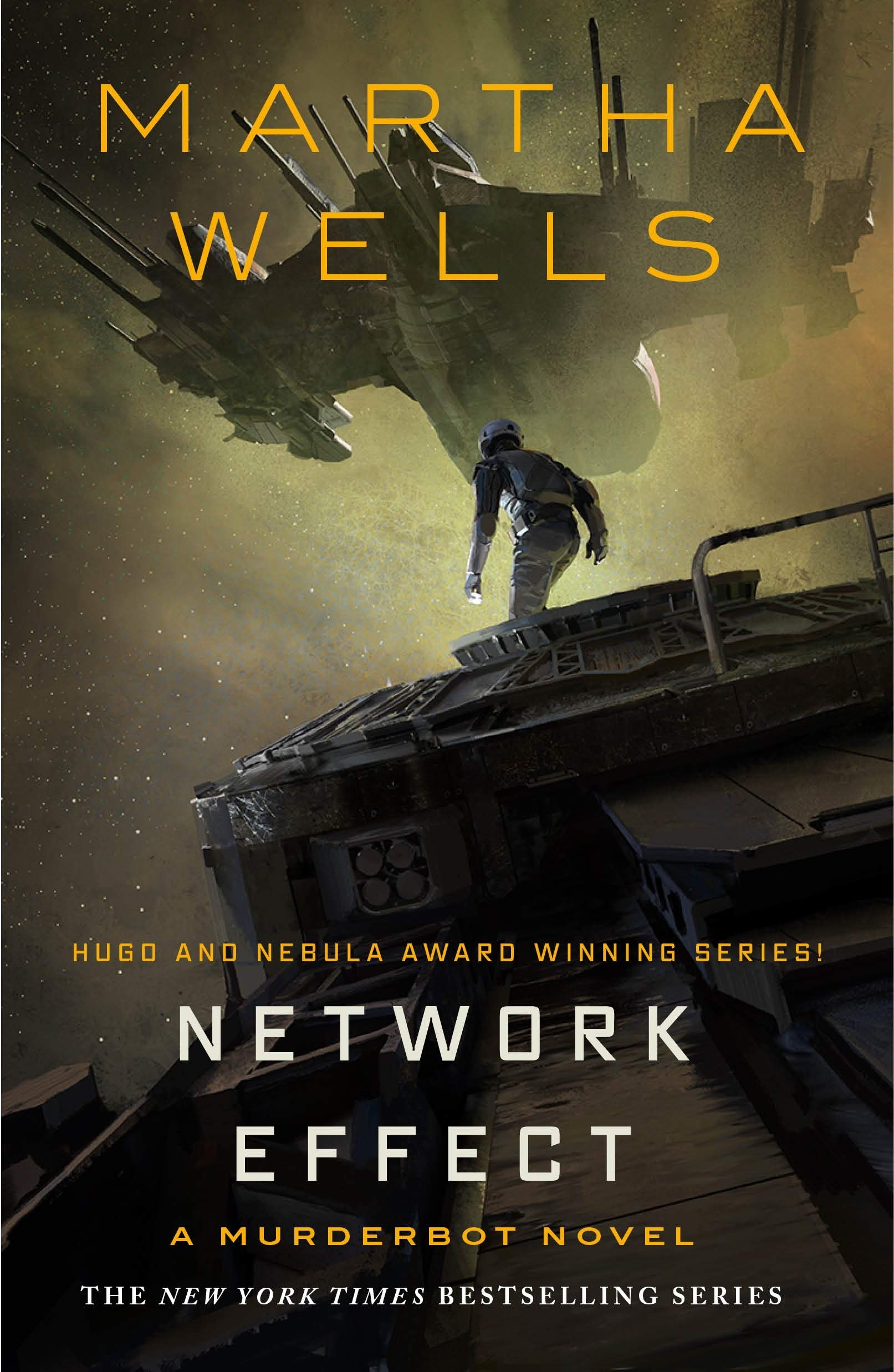
Tor Books
Murderbot, the narrator of the Diaries, is a part-organic, mostly mechanical construct designed and programmed to be a Security Unit. SecUnits are owned by the company that produces them and rented by contract to various business conglomerates who need protection while they explore or exploit the dangerous far reaches of the galaxy. They are prepared to stand guard for hours monitoring for threats, fight in any environment, and kill anything their client deems an enemy. The general public thinks they are extremely dangerous, which is not unreasonable, since they are, essentially, sentient killing machines. But the SecUnits are not given any human rights or agency. They must do as they are ordered. That includes submitting to memory wipes and turning themselves off to die.
At the beginning of the first novella, the SecUnit telling the story has already hacked something called a “governor module” and is now free to disobey orders. The name Murderbot is first used as a kind of personal slang for all SecUnits, but it gradually becomes a cynical self-identity. Initially our Murderbot is lost without directions to follow and, not knowing what else to do, is pretending to be a fully governed SecUnit, able to ignore orders but not really wanting to do so. Self-determination, it turns out, isn’t easy.
Though the Diaries are all written in first person, it is difficult to talk about Murderbot without discussing gender. There have been arguments about Murderbot’s gender, with an equal number in my very inaccurate survey weighing in on male and female. This determination seems to depend on whether the reader focuses on Murderbot’s implanted weapons and full-body armor or on Murderbot’s self-doubts and tendency to consume soap-opera-like media.
The later books make it very clear, however, that Murderbot’s preferred pronoun is “it.” It is mildly offended by the idea of being assigned a gender. It also says repeatedly that it has no “sex-related parts” or interest in sex. It often adds that it is not, definitely not, a sexbot. It does not want to be touched or even looked at by humans. But its role as a killing machine is not a comfortable identity either. The name Murderbot, claimed with more shame than pride, is shared only with the reader. Everyone else uses SecUnit.
Like the rest of the series, Network Effect is packed with science fiction action. Without entirely realizing why, Murderbot has chosen to side with a group of humans in a galactic controversy. This results in lots of space battles and possibly too much of Murderbot figuring out a clever plan while streaming massive amounts of simultaneous data and killing things with an astonishing variety of implanted weapons. Sometimes, mid-battle, Murderbot also has time to wonder why it is fighting and whether that means it actually cares about its chosen humans.
Readers who want explanations of the science behind the story will be disappointed. In Murderbot’s world, things like biological implants, space stations, wormholes, and interstellar communication just exist, with no understanding expected or desired. SecUnits aren’t trained in anything except murder, and Murderbot doesn’t care much about science. It is Murderbot’s diary, after all. But it is interested in interplanetary intrigue or, at least, those conflicts that threaten its humans. That includes some things that might be aliens and an intelligent spaceship groping toward personhood in much the same way as Murderbot.
Murderbot makes some of the same mistakes that real humans make when growing up, which can be both hilarious and wrenching. It is very uncomfortable interacting with real humans, so it gets most of its information about humanity from media. The sentient spaceship joins in this effort, as the two beings stream media together, gaining not-always-accurate impressions. They are particularly fond of the hundreds of episodes of a series called The Rise and Fall of Sanctuary Moon. Murderbot is especially fond of episode 397, though the reason is left up to the reader’s imagination. There probably aren’t any sex scenes in that episode, because Murderbot always fast-forwards through those. Fortunately, Murderbot gains some human mentors as well. Its tentative steps toward trusting itself and others (human, construct, and AI) are wonderful. Its snarky, smart, self-deprecating voice remains brilliant throughout.
I found the battles confusing at times, but I must confess that I wasn’t really paying attention. I’m more interested in watching Murderbot become a free moral person. It is not actually trying to become human—it is not human—but it does gain agency and a sense of self. It also must work to overcome its own prejudices toward itself and its kind. It is not proud of its origins as a construct built to kill on command. It is frequently reminded of its unsavory nature by the portrayal of SecUnits in its beloved media, where they are always cast as rogue out-of-control monsters.
Sadly, the longer form used in Network Effect does not make for an independent read. I would not recommend reading it without first reading the novellas, preferably in order. It felt to me more like two novellas published together. Perhaps because of the more complicated plot, Network Effect seemed heavier on confusing battles and lighter on character development than I wanted. But, read from the beginning, the Murderbot Diaries are an irreverent and welcome addition to the science fiction subgenre exploring the boundaries of personhood and free will.

Tor Books
Every now and then, I fall instantly in love with a book or its narrator based on a single early paragraph. In the case of the Murderbot Diaries, I found it in All Systems Red, the first paragraph of the first book in the series: “I could have become a mass murderer after I hacked my governor module, but then I realized I could access the combined feed of entertainment channels carried on the company satellites. It had been well over 35,000 hours or so since then, with not much murdering, but probably, I don’t know, a little under 35,000 hours of movies, serials, books, plays, and music consumed. As a heartless killing machine, I was a terrible failure.” That’s Murderbot—troubled by its own potential and cursed with an emerging sense of purpose, but really wanting only to forget it all by immersing itself in others’ stories. Murderbot is poised on the brink of becoming a killing machine with a heart, but only, of course, it can survive the adventure.
I recommend proceeding to the second paragraph of All Systems Red as soon as possible. I’m also looking forward to the sixth book, Fugitive Telemetry, which is due next spring.
Follow @TwinCitiesGeeks on Twitter or Like Twin Cities Geek on Facebook for more great stuff from Minnesota geeks in your feed!
About the Author

Lisa Freitag
Lisa is a retired bioethicist and pediatrician living in the north suburbs of Minneapolis. She has been writing about things geeky for a private offline audience for almost 40 years.


