
5 Common Coronavirus Questions Answered by the Experts
I am writing this not as an old lady with a naïve attitude toward anime (my usual role at Twin Cities Geek) but as a physician who practiced pediatrics for 25 years. Because of this shady past, many people have been coming to me with questions about how to deal with the COVID-19 pandemic. I began by haunting the CDC websites and reading general-audience articles by people who probably know what they are talking about. This was not terribly satisfying. Eventually, I decided to look directly in medical journals. Thankfully, information about COVID-19 that would normally be behind a paywall is being made available to everyone—I have been able to find recent medical articles from journals that I have not been able to access since dropping my expensive subscriptions years ago.
This is not, by any stretch, a complete inventory of medical papers. But here are some answers to specific questions I have been hearing.

Recent scanning electron microscope image of SARS-CoV-2 from the National Institute of Allergy and Infectious Disease. NIAID-RML
How Is the Virus Spread?
Source: “Transmission of 2019-nCoV Infection from an Asymptomatic Contact in Germany” (C. Rothe et al., New England Journal of Medicine, March 5, 2020)
By now, we know the answer to this, but it was a burning question in China in December and in the rest of the world in January. The virus that causes the COVID-19 disease, officially known as SARS-CoV-2, emerged in China, probably from a mutated coronavirus that initially infected only animals. Before Chinese health authorities confirmed that they were dealing with a novel coronavirus disease, there was hope that the disease was spread only by direct contact with animals in certain parts of the country and thus would not become a problem outside China. Obviously, that was not true.
The DNA sequence of the new virus was released in early January, and was quickly needed by researchers around the world, including this group in Germany (where it was called 2019-nCoV). This report provided clear early evidence that human-to-human transmission outside of China was not only possible but was occurring in an extremely worrisome manner.
A healthy person from China attended a business meeting in Munich in January. On the day of her return to China, she became ill and tested positive for the virus. A few days later, on January 24, two German businessmen who had attended the meeting fell ill with cough, fever, and muscle aches. Two days after that, two other people who had not been at the meeting fell ill; they had been in contact with one of the German businessmen before he’d shown any symptoms. All tested positive, though all but one were recovering by the time the German researchers were able to develop a test. All were doing fine at the time of publication. It was disturbing that viral transmission occurred with fairly casual contact and during times when the initial patients had no symptoms.
For more about how transmission actually happens, see the next section.
Is My Mail Safe? Or, How Long Does the Virus Last on Surfaces?
Source: “Aerosol and Surface Stability of SARS-CoV-2 as Compared with SARS-CoV-1” (N. van Doremalen et al., New England Journal of Medicine, March 19, 2020)
There have been so many warnings about surface contact, hand sanitizer, and wiping down everything with bleach that I have had to work to convince people that, actually, the virus is mostly spread by airborne particles and droplets. Humans are mobile virus factories, and viruses use their hosts to launch their hopeful offspring into the unknown. We help them far more by coughing, sneezing, spitting, talking, and even breathing than we do by touching things.
This paper is the most recent of those I found, published on March 17 in the New England Journal of Medicine. The researchers tested SARS-CoV-2 as well as SARS-CoV-1, a related coronavirus that got quite famous in medical circles a couple years ago but turned out to not be as big a threat as feared.
These researchers essentially sprayed huge amounts of each virus on various surfaces and then checked to see how long the viral particles remained intact. They also aerosolized each virus in a chamber, which they maintained for three hours. In the surface tests, they found SARS-CoV-2 lived on plastic surfaces for 72 hours, stainless steel for 48 hours, cardboard for 24 hours, and copper for 4 hours.
There are, of course, limitations to the conclusions that can be made from this, including that the study has not yet been peer-reviewed or confirmed in other labs. However, the 24-hour viability time for cardboard probably means, happily, that your packages and letters are safe by the time they arrive, even if someone coated them with snot before sending them. (I’m pretty sure that paper and cardboard look the same to a virus.) If you are worried that your mail carrier might spray virus on your mail when delivering it, you can always wait 24 hours before handling it. You might then also want to sanitize your stainless steel or plastic mailbox.
Unfortunately, the aerosol study was not so encouraging. In three hours, there was a reduction in the number of “viable viral particles,” but there were still plenty left. This means that if your roommate has COVID-19, you have probably been exposed no matter how much Lysol you used, unless you live in a Downton Abbey–sized mansion. Virus placed in a small chamber cannot diffuse into the surrounding air, as it would outdoors or in a large indoor space.
The researchers in no way documented that the virus is definitely spread by surface contact or by aerosol—there is no guarantee that a virus that looks “viable” after three hours can actually cause infection. But their results suggest that contamination from surfaces is possible, and that spread by aerosol is likely.
This raises the question of wearing surgical face masks. These masks were never meant to stop aerosolized viruses, which go right around the edges, as well as right through the mask fabric. Masks were designed so that your surgeon wouldn’t drool, cough, sweat, or sneeze into the sterile surgical area. It is totally possible that coffee filters would work just as well. Surgical masks do, however, block droplets. So, if you are coughing, sneezing, spitting, or drooling, you might want to get hold of some masks (probably by making your own given current availability). They will not protect you, but they might protect the people around you.
What Does a COVID-19 Case Look Like?
“First Case of 2019 Novel Coronavirus in the United States” (M. L. Holshue et al., New England Journal of Medicine, March 5, 2020)
When people call you up to ask whether you think their symptoms are indicative of a potentially fatal infection, you have to be fairly cautious about your answer. Since I’m no longer practicing medicine, I don’t have direct experience with any cases of COVID-19. Reports of cases from a personal perspective are multiplying, but they are confusing and rarely contain useful medical information. This handy paper is a full report, including chest x-rays and lab results, of the first patient reported in the US, which happened on January 19 in Snohomish, Washington.
The patient was a 35-year-old man who developed a cough and fever four days after returning from Wuhan, China. He had a long (11-day) but fairly uncomplicated hospital course and eventually got better. However, during his hospital stay, he had enormous amounts of the virus everywhere he was tested, even when he didn’t have very many symptoms. It took 11 days before repeated COVID-19 tests were negative, indicating that the virus had been cleared.
The patient’s main symptom was a cough, which he still had even after the negative test. He also had a fever and fatigue for most of that time. He briefly had vomiting, diarrhea, and stomachache, and he did have the virus in his stool. He had a runny nose for one day, late in the course of the illness. He had some minor pneumonia on chest x-ray and a somewhat low white blood count.
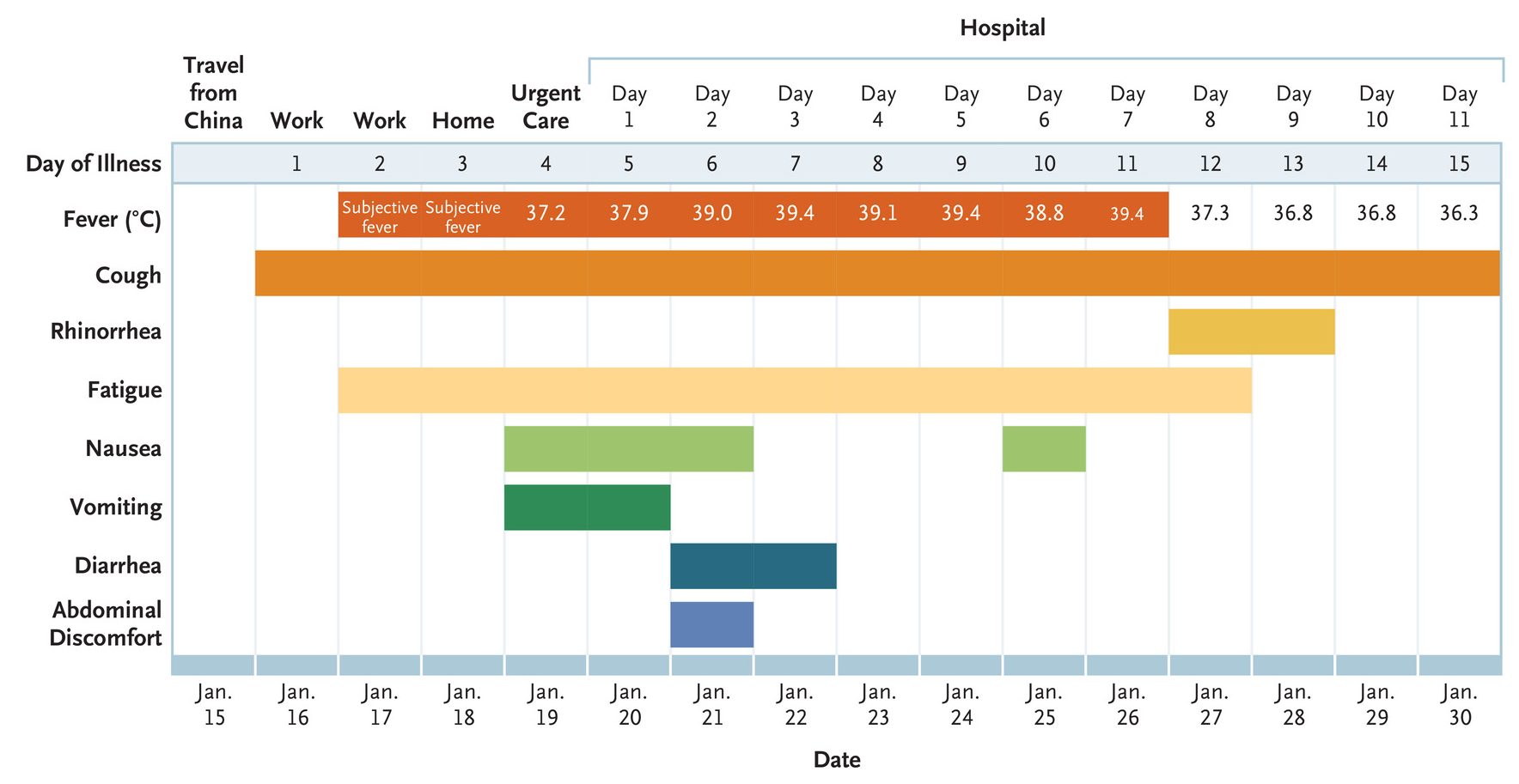
The chart of the timeline of illness from the New England Journal article.
This picture fits with most of the other reports of hospitalized COVID-19 patients. Cough and fever with a mild pneumonia on chest x-ray or CT are the main worries. But there are reports of people who have no symptoms at all and, unfortunately, many reports of people who develop respiratory distress about five days into the illness and require high-pressure oxygen or ventilation. Some of these patients die.
On that subject, my next question is one I wanted to know for myself.
How Does COVID-19 Kill People?
Source: “Pathological Findings of COVID-19 Associated with Acute Respiratory Distress Syndrome” (Z. Xu et al., the Lancet, February 17, 2020)
I wanted to answer this question merely to satisfy my own curiosity, so I read this pathology report from China, published in mid-February in the Lancet. It is the autopsy report from one 50-year-old man who died from respiratory failure due to COVID-19. The man had a mild cough and fever for about a week, then was admitted to the hospital with difficulty breathing and pneumonia. He slowly worsened, and he died of acute respiratory failure on his sixth day in the hospital. Microscopic examination of his lungs showed that he died of acute respiratory distress syndrome (ARDS). Four very pretty color slides are provided in the paper.
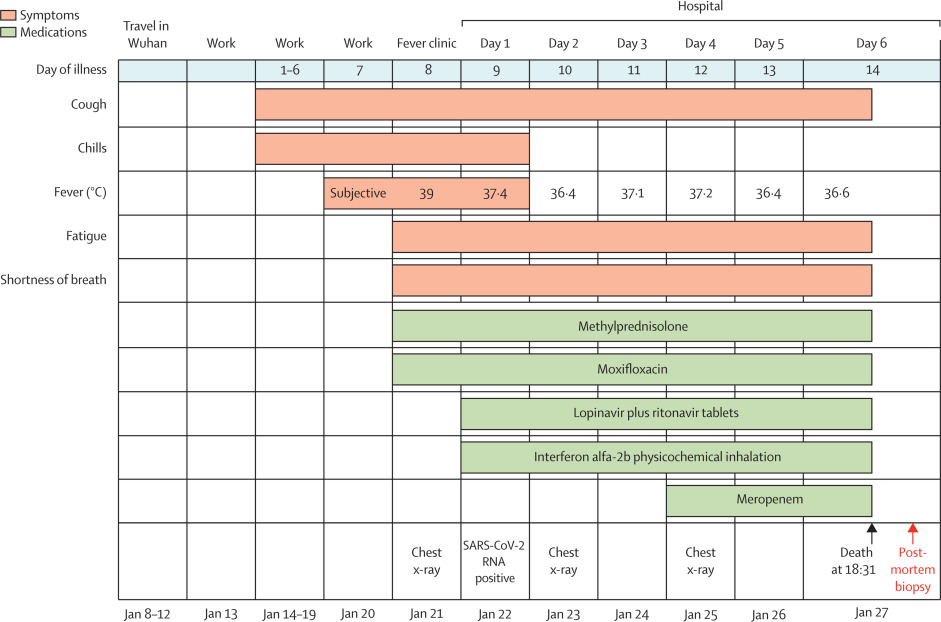
This chart from the Lancet shows the patient’s course of illness over the fourteen days prior to his death.
As a physician, I find the connection to ARDS to be the most concerning problem with COVID-19. The virus has been known from the first to primarily attack the lower respiratory tract (often causing pneumonia). The progression to ARDS seems likely to be the cause of most of the deaths and prolonged serious illnesses.
ARDS occurs when the alveoli in the lungs fill with fluid and collapse, impeding air flow in and out of the lungs. The membranes that separate air and blood in the alveoli become thickened and stiff. Gasses must pass (diffuse) through this membrane in order to exchange carbon dioxide for oxygen in the bloodstream. If too much of the gas-exchange surface is lost, the molecular exchange of CO2 and O2 across this membrane can’t happen, and there is very little that can be done.
ARDS is a rare cause of death in some cases of severe trauma, sepsis, drowning, and multiple organ failure. The mechanism for the cascade of events that leads to it is complicated and seemingly different in each type of case but involves a destructive overreaction by the immune system. In this study, the researchers found virus in the patient’s alveoli as well as signs (in his lungs, liver, and blood) consistent with “severe immune injury.” So far, there does not seem to be a way to predict which patients will go into ARDS with any infection, let alone with this brand-new coronavirus. And while anti-inflammatory and antiviral drugs sometimes help with other viruses, so far no one seems to have found a reliable way to halt this one.
Can We Predict the Risk for Severe Infection?
Source: “Clinical Characteristics of Coronavirus Disease 2019 in China” (W. J. Guan et al., New England Journal of Medicine, February 28, 2020)
This paper is likely the largest summary of clinical experience with COVID-19 published so far. Within three weeks following its publication, it had already been cited over 100 times. It is dense with statistics gathered from hospitalized patients with documented SARS-CoV-2 infections from all over China, but the short answer to the question of whether we can predict the risk for severe infection is no.
For this paper, researchers merely requisitioned the medical records of all patients with positive COVID-19 tests reported to the Chinese National Health Commission in December and January, then mined them for data. They analyzed 1,099 charts. This is a frighteningly high number of hospitalizations to have less than two months after the emergence of a previously unknown virus.
The researchers were able to determine an incubation period (the time between contact with the virus and the first symptoms) based on data from the 291 people who could pinpoint a date of contact. They calculated a median of four days, with a range of two to seven days, across all age groups. Disappointingly, though, the researchers were not able to establish a pattern of illness in the early stages that would predict outcome.
Almost all of the patients studied had fever (88 percent), but not always in the first few days. Almost all of the patients were diagnosed at some point with pneumonia, which developed on the third to fifth day after symptoms first appeared. But not all had abnormal chest x-rays or CT scans initially. Cough was eventually present in 68 percent of patients. Average hospital stays seemed to be about two weeks.
After that, it gets difficult to interpret. The researchers categorized 173 of the 1,099 patients as “severe” at the time of presentation. Of these, 67 later required mechanical ventilation. But there were only 55 patients total in the ICU, 22 in the “nonsevere” group and 33 in the “severe” group, which doesn’t make sense to me. The total number of patients with ARDS was 37. There were a total of 15 deaths. Unfortunately, “many” of the 1,099 patients were still in the hospital at the time of publication, so no overall outcome statistics for any group could be obtained.
This is a long paper, and 5 of its 13 pages are in the form of spreadsheets showing everything from patients’ ages and smoking histories to laboratory and x-ray findings. But the more I scrutinize it, the less useful it seems. The paper is mostly aimed at clinicians evaluating the early stages of a respiratory illness (cold) for the possibility of a COVID-19 infection. Perhaps its most significant finding is that fever and chest x-ray changes may develop later and may not be present at the beginning of the illness.
Feel free to scrutinize the data yourself at the link above and see whether you can come up with anything predictive or useful. Remember as you do, though, that this is data from hospitalized patients only. The authors say themselves that their data does not include asymptomatic and mildly ill patents, so accurate statistics about the overall rates of severe illness, ARDS, and death among all people who contract COVID-19 cannot be derived from their study.
Conclusion
There is no doubt in my mind that we are dealing with a life-changing pandemic that will be with us for some time to come. However, I believe that, for most of us, the change will be first and foremost in how we live our lives, not how healthy we are.
I’m speculating now, but it is likely that many of us will “get” this virus at some point, no matter how careful we are. Fortunately, for most people this will present as a cold (possibly an awful cold with muscle aches and fever) for a couple days, and then they will get better. Some people will have no symptoms at all. But some people will develop a bad cough and fever, indicative of pneumonia, and might need up to several weeks in the hospital. A few of these will go on to develop ARDS, but not without several days’ advance warning.
There is no need for alarm unless someone has labored breathing, rapid respiratory rate, and shortness of breath. If you have those symptoms, I would tell you to contact a hospital even if there weren’t a coronavirus pandemic.
Further reading on COVID-19:
If you’d like to keep tabs on COVID-19 news and discuss with other local geeks, you can join us on the Twin Cities Geeks Slack, which has two channels dedicated to the pandemic.
Follow @TwinCitiesGeeks on Twitter or Like Twin Cities Geek on Facebook for more great stuff from Minnesota geeks in your feed!
About the Author

Lisa Freitag
Lisa is a retired bioethicist and pediatrician living in the north suburbs of Minneapolis. She has been writing about things geeky for a private offline audience for almost 40 years.


