
Kyō Kara MAOH! Is a Perfect Bathtub Melodrama
A rather long time ago, at a rather serious science-fiction convention, I attended a panel on the value of speculative fiction as literature. This was before the serious term speculative fiction was widely used, so the panelists were desperately trying to prove that books called “sci-fi” should be taken seriously. To do this, they separated the genre into “literary” books, the reading of which raises one’s consciousness and social status, and books that were good only for reading in the bathtub. As happens at this sort of discussion, things went rapidly downhill as various people tried to defend their own favorite “bathtub books” and promote the value of reading merely for fun.
Kyō Kara MAOH! is the manga/anime version of a bathtub book. There is no way to pretend that it holds any long-lasting literary value; no one will discuss it in a film class, even a film class that includes animation. No one will brag about owning signed first editions of the manga. No one would be particularly offended if someone accidentally dropped it in the bathtub. It is pure silliness and enjoyment.

Crunchyroll
The manga Kyō Kara MAOH! was created by Temari Matsumoto, based on light novels by Tomo Takabayashi. The first volume was released in Japanese in 2005, and in English translation in 2008. The anime seems to have been made at about the same time. There are many manga volumes, but only the first six or so were translated and printed in English. The anime is much longer, with three seasons totaling 117 episodes (not counting five OAV episodes). In English, it has been given the title God(?) Save Our King, though the Japanese actually translates closer to Demon King from Now. (Kyō means “today” or “now.”) I’m going to stick with the title from the translated manga, including putting MAOH (Demon King) all in capitals for no obvious reason.
We old ladies who watch anime together have been making our way through the first two seasons of this series for some time. We have been trying to hurry, since we borrowed the DVD collections from a friend who is a woman of about the same age as we are but may not actually identify as an old lady). But I have to admit that I’ve been wanting to delay the return of her DVDs, since they are a relaxing and unchallenging way to start an evening of anime. So we were very excited to learn that Crunchyroll started streaming the first two seasons last summer. (Not being up to date on such things, we only just found out.) We were even more excited to learn that there is a third season now available, with another 39 episodes! Alas, none of us has an onsen in our backyard, or even a hot tub, from which to enjoy them.
Kyō Kara MAOH! stars Yuri Shibuya, an ordinary baseball-loving teenager who is wafted to a fantasy world, where he is hailed as the 27th Maoh of Shinmakoku (Great Demon Kingdom). He does not get to Shinmakoku by any of the usual routes—no antique wardrobes or mysteriously shimmering gates here. Instead, he’s flushed down the toilet by bullies on the way home from school. He thinks he’s been dropped into some German fairy-tale theme park until guys with swords show up to fight over him. Even he notices that the guys with swords are all very attractive.
He is taken to the ominously-named Blood Pledge Castle, where he meets the rest of the cast: the 26th Maoh, a loud, busty woman, and her three sons, plus assorted castle staff. The 26th Maoh has, we are told, given up the throne in order to travel the world looking for love. Seemingly, she has already found a lot of love, since her sons all have different fathers and, thus, different last names. Their complicated, European-styled names provide unintended moments of hilarity for me, since they seem to be difficult to pronounce in Japanese. (The silliness of the names might be intentional: later, we meet three friendly, happy serving maids with the names Doria, Sangria, and Lasagna.) Though Yuri’s suitability for Maoh-ship is occasionally questioned, none of the outgoing Maoh’s handsome sons, or their fathers, seem particularly interested in ruling the kingdom.
The plot, such as it is, progresses in wild story arcs that really don’t hold up under detailed analysis. There is, however, no need for such scrutiny. There are the usual fantasy quests, adventures by boat or on horseback, to acquire a special sword or retrieve an ancient artifact. Yuri is randomly yanked back to the real world, not always at convenient times or while he is appropriately dressed. He always travels between the worlds via water, usually by some version of falling down the drain.
The general direction of the plot is that Yuri, rather than killing all the humans in the endless war, as expected from a Maoh, wants everyone to be friends. He gradually succeeds in this, happily uniting Shinmakoku and the surrounding human countries with his earnest goodwill and kindness. It also helps that when he gets really angry, he turns into a grown-up demon that radiates magic and rains (literally) destruction on his enemies, after which he collapses. It’s really kind of sweet.
The cover copy of the manga describes Kyō Kara MAOH! as “Temari Matsumoto’s outrageous, gender-bending high-school alien love story,” but it’s not really a love story. Yuri does accidentally propose to the youngest son, named Wolfram (Worofuramu in Japanese), in one of the early episodes. Everyone takes this completely seriously, but nothing much happens between them. Just the word engagement makes Yuri blush furiously, and Wolfram doesn’t push the relationship except to go into fits of jealousy if anyone else pays attention to Yuri. I’m not sure this counts as “gender bending,” though maybe it did in 2005.
I don’t think the word “alien” in the description is quite right either. Yes, the inhabitants of the other world are supposed to be demons, but the demons all look like humans, just abnormally beautiful ones. And there are half humans, including the middle brother Conrad (Konorato), who don’t have any magic but are still pretty handsome. And “high school,” too, may be a bit of a stretch. Yuri is in high school when he’s home in Japan, but Wolfram is offended when Yuri thinks they are the same age and states that he is 82 years old. I think the only word in the description that’s is correct is “outrageous.” Yes, indeed. Outrageous it is.
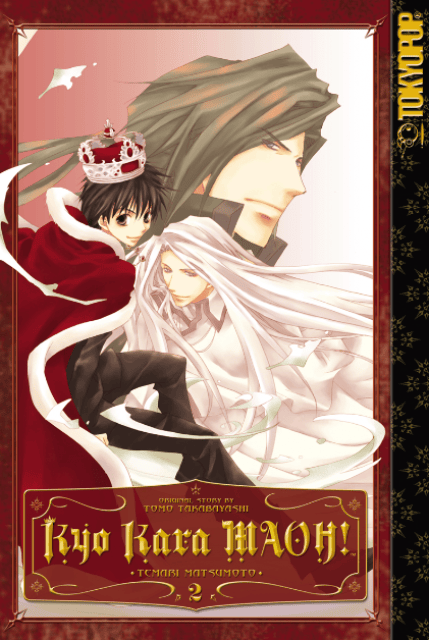
Tokyopop
We old ladies think the most accurate literary description for Kyō Kara MAOH! is melodrama, the bathroom-book form of drama. In melodrama, no one bothers much with world-building or creating a consistent story. The idea instead is to create a series of over-the-top encounters between exaggerated characters, leading to an emotionally satisfying outcome. In the usual beautiful-woman-tied-to-the-railroad-tracks scenario, for example, it really doesn’t matter why this is done or that this is a really stupid way to go about it. The payoff is in the relief of rescue after the suspense generated by peril that is too dire to be taken completely seriously. Perhaps what is really gender-bending about Kyō Kara MAOH! is that all the characters placed in improbable danger are men.
Because of the ridiculous situations and overblown dialogue, the most fun melodramas are comedies. The characters, however, must take themselves terribly seriously, despite high levels of absurdity. (In a live melodrama, actors will occasionally react to the audience’s laughter with astonishment, as though they can’t imagine what might be so funny.) In its earnestness and utter seriousness, Kyō Kara MAOH! is hilarious and surprisingly endearing. With a few exceptions in the first season when actual attempts to be funny fail completely, you can’t help but giggle even as you’re being totally drawn into the characters’ harrowing encounters. They would have no idea what you find so amusing.
The Japanese voice actors, too, seem to have an understanding of melodrama and usually hit the right level of noble concern in the midst of danger. Sadly, the soundtrack, particularly in the first season, is fairly intrusive. Later episodes improve considerably, however, and eventually the series acquires actual orchestration! The animation is also fairly minimal, as expected from something done quickly in 2005. This also improves, which means that the guys get prettier with each season, a welcome improvement if the whole point is to watch beautiful men throw themselves into danger. If you really want 2D handsome men, though, I recommend the manga, where the drawing is much finer. (Unfortunately, the six volumes legally available in English only get you halfway through season 1.) The writing also gets tighter with each season but never loses its essential silly seriousness.
It is probably best not to marathon too many episodes at once. Bathtub books are, after all, suspected of being a waste of time, something that lowers one’s appreciation of true literature. We recommend watching in short bursts, not necessarily in order. In the first season, you can fast-forward if you catch anyone actually trying to be funny. We like the Japanese version with subtitles best. If possible, watch it from the hot tub in your backyard.
Follow @TwinCitiesGeeks on Twitter or Like Twin Cities Geek on Facebook for more great stuff from Minnesota geeks in your feed!
About the Author

Lisa Freitag
Lisa is a retired bioethicist and pediatrician living in the north suburbs of Minneapolis. She has been writing about things geeky for a private offline audience for almost 40 years.


